Mitakon 35mm f/0.95 II review (2016 test)
by Georgy Romanov · Gear Tests
As an Amazon Associate I earn from qualifying purchases. Links to Amazon on this page are affiliate links.
Verdict: The Mitakon Speedmaster 35mm f/0.95 Mark II is a small, metal, manual f/0.95 lens with a strong character. Buy it if you shoot portraits and low light and like a soft, unusual rendering. Skip it if you need autofocus, crisp edges wide open or chrome subjects free of fringing.
Who the Mitakon 35mm f/0.95 is for
The Mitakon Speedmaster 35mm f/0.95 Mark II is for photographers who want an f/0.95 lens without an f/0.95 price. Lenses this fast can be counted on your fingers. Most are expensive, each has a distinct rendering, and every one starts arguments: about bokeh, about price, about whether anyone needs that much aperture. A new lens in this class is an event. A budget one is a rarer event still.
| Buy it if | Skip it if |
|---|---|
| You shoot portraits and can take your time to focus | You shoot moving subjects wide open |
| You want an unusual, soft rendering at f/0.95 | You want a clean, predictable "reference" picture |
| You work in low light on an APS-C camera | You need autofocus |
| You want a compact metal lens, 460 g (16.2 oz) | You shoot chrome or bright highlights wide open |

As the name says, this is the second version of the lens. Zhong Yi Optics makes it in China for Sony E, Fuji X and EOS-M mounts. The company was founded in 1984 with money from Japanese investors and has made optics from its first day. It became known for relatively affordable manual ultra-fast lenses for mirrorless cameras. The test copy came in the Fuji X version and was mounted on a Fujifilm X-E2.
Mitakon Speedmaster 35mm f/0.95 Mark II specifications
The table lists the review's figures, with the maker's current numbers where they add something or differ.
| Specification | Mitakon Speedmaster 35mm f/0.95 Mark II |
|---|---|
| Format | APS-C |
| Mounts at test time | Sony E, Fuji X, EOS-M |
| Equivalent focal length | 52.5 mm on APS-C (maker's figure) |
| Angle of view | 43.5° (maker's figure) |
| Optical design | 11 elements in 8 groups |
| Aperture | f/0.95 to f/16, de-clicked ring |
| Aperture blades | 9, rounded |
| Minimum focus distance | 0.35 m (1.1 ft) |
| Maximum reproduction ratio | 0.13x (maker's figure) |
| Filter thread | 58 mm in the review; the maker's page lists 55 mm |
| Size | 60 mm (2.4 in) long, 63 mm (2.5 in) across |
| Weight | 460 g (16.2 oz) |
| Body | Metal, engraved and painted scales in meters and feet |
| Focus | Manual only |
What changed since the test (checked November 23, 2026): the Zhong Yi Optics product page still sells the lens as in stock and calls it the Mark II. Its mount selector now also offers Nikon Z and Canon RF. It lists 11 elements in 8 groups, 9 blades, a 35 cm minimum focus distance and a 63 × 60 mm body, which match the test. Two figures differ: the page gives a 55 mm front filter thread where the review says 58 mm, and a weight range of 390 to 460 g. Check the filter size on your own copy before you buy filters. A site search for a Mark III of the 35mm returned nothing on that date.

Build quality and the focus ring
The lens is compact and light for its aperture. At 460 g and 60 mm long, it is the size of an ordinary standard prime. The maker's launch note puts the Mark II 220 g below the first version. On the Fujifilm X-E2 it made a balanced pair that sits well in the hand.
The barrel is metal. The focus scale is marked in meters and feet, and all figures are engraved and painted. The finish left a very pleasant but not perfect impression. The focusing helicoid has a little play, a reminder that this is a budget lens and not a legendary Leica. That play has no effect on the pictures. Set against the price of brand-name ultra-fast lenses, it hardly counts as a flaw.
For a manual lens, the feel of the focus and aperture rings matters more. They should be neither stiff nor loose, and the grease in the helicoid sets that balance. The test lens uses a fairly thick grease, so both rings turn a little stiffly. On a stepless aperture ring that has an upside: you will not knock the setting by accident. A repair shop can replace the grease with a softer one, and the job is not expensive.
Shooting at f/0.95 with manual focus
Hitting focus at f/0.95 takes practice. At first the reviewer kept missing, because the depth of field is so thin. After a while he got the hang of it and began to land focus even wide open. Moving subjects at f/0.95 with manual focus remain a challenge: as soon as you move, focus drifts, or worse, it drifts one way while the subject goes another. In those cases, stop down for more depth of field.
Portraits are different. You have time to prepare, focus calmly and take the shot. Here the X-E2 helps: its rangefinder-style focus aid and a magnified preview on one assigned button make manual focus pleasant and fairly efficient. The focus and recompose habit, by contrast, is risky at this aperture, as the table below shows.



This series shows how the bokeh changes and the zone of sharpness grows at close range: f/0.95, then f/1.4, then f/2. The reviewer's view is that the lens shows its character at close range. The focus ring agrees. Its throw is long, and most of it covers 0.35 to 3 m (1.1 to 9.8 ft).
How thin is the depth of field at f/0.95?
At 1 m (3.3 ft), the whole zone of acceptable sharpness at f/0.95 is about 3 cm (1.2 in) deep. At the minimum focus distance it shrinks to under 4 mm. That is why focus misses come easily, and why the near field is where this lens draws attention.
The short answer: at f/0.95 and 1 m, about 3 cm is sharp. At 0.35 m, under 4 mm. Focus on the near eye and do not recompose.
| Focus distance | f/0.95 | f/1.4 | f/2 | f/2.8 |
|---|---|---|---|---|
| 0.35 m (1.1 ft) | 3.6 mm | 5.3 mm | 7.6 mm | 10.6 mm |
| 0.5 m (1.6 ft) | 7.4 mm | 10.9 mm | 15.5 mm | 21.7 mm |
| 1 m (3.3 ft) | 3.0 cm (1.2 in) | 4.3 cm (1.7 in) | 6.2 cm (2.4 in) | 8.7 cm (3.4 in) |
| 2 m (6.6 ft) | 11.8 cm (4.6 in) | 17.4 cm (6.9 in) | 24.9 cm (9.8 in) | 35.0 cm (13.8 in) |
| 3 m (9.8 ft) | 26.6 cm (10.5 in) | 39.3 cm (15.5 in) | 56.3 cm (22.2 in) | 79.5 cm (31.3 in) |
How the numbers were computed. Hyperfocal distance H = f² ÷ (N × c), with f = 35 mm and c = 0.019 mm, the d/1500 value that Wikipedia's circle of confusion page lists for Nikon, Pentax and Sony APS-C. The maker's 52.5 mm equivalent gives a crop factor of 52.5 ÷ 35 = 1.5, the same size class. Near limit = u × H ÷ (H + u), far limit = u × H ÷ (H − u), and depth of field is far minus near, as on Wikipedia's depth of field page. Example at f/0.95 and 1 m: H = 1225 ÷ 0.01805 = 67.9 m, so the zone runs from 985.5 mm to 1015.0 mm, a depth of 29.5 mm.
The table also settles a common worry. Opening from f/1.4 to f/0.95 gains 2 × log₂(1.4 ÷ 0.95) = 1.12 stops of light. The depth of field shrinks by the same ratio as the f-number, 0.95 ÷ 1.4, so you lose about a third of an already thin zone. At 3 m that is the difference between 39 and 27 cm, which a seated portrait survives. At 0.5 m it is 11 mm against 7 mm, the depth of an eyelash and an eye.
Bokeh at every aperture
Wide open, the blur is harmonious and fairly even. That comes from the 9 rounded blades, and it holds at f/0.95 and f/1.4. Transitions between planes are soft, which helps the pictures. At f/2 the outlines of the background start to show, and the car headlights in the series below begin to double. That does not spoil the overall impression. As you stop down further, depth of field grows and the magic gives way to rougher reality.



The full series ran from f/0.95 to f/16, each frame one stop further down. Nobody can accuse this lens of lacking a character of its own. Its rendering is unlike that of a modern, fully corrected lens.
How sharp is it, aperture by aperture?
The center is portrait-sharp at f/0.95 and excellent from f/2. The edges need f/4. The sharpness test was focused at infinity, where you judge overall sharpness more than bokeh.
| Aperture | Center | Edges |
|---|---|---|
| f/0.95 | Good portrait sharpness | Clearly soft, slight swirl |
| f/2 | Excellent | Still soft, slight swirl |
| f/2.8 | Excellent | Still soft |
| f/4 | Sharper still | Softness and swirl gone |
| f/8 | Peak sharpness | Sharp |
| f/16 | No significant loss, fully usable | Sharp |
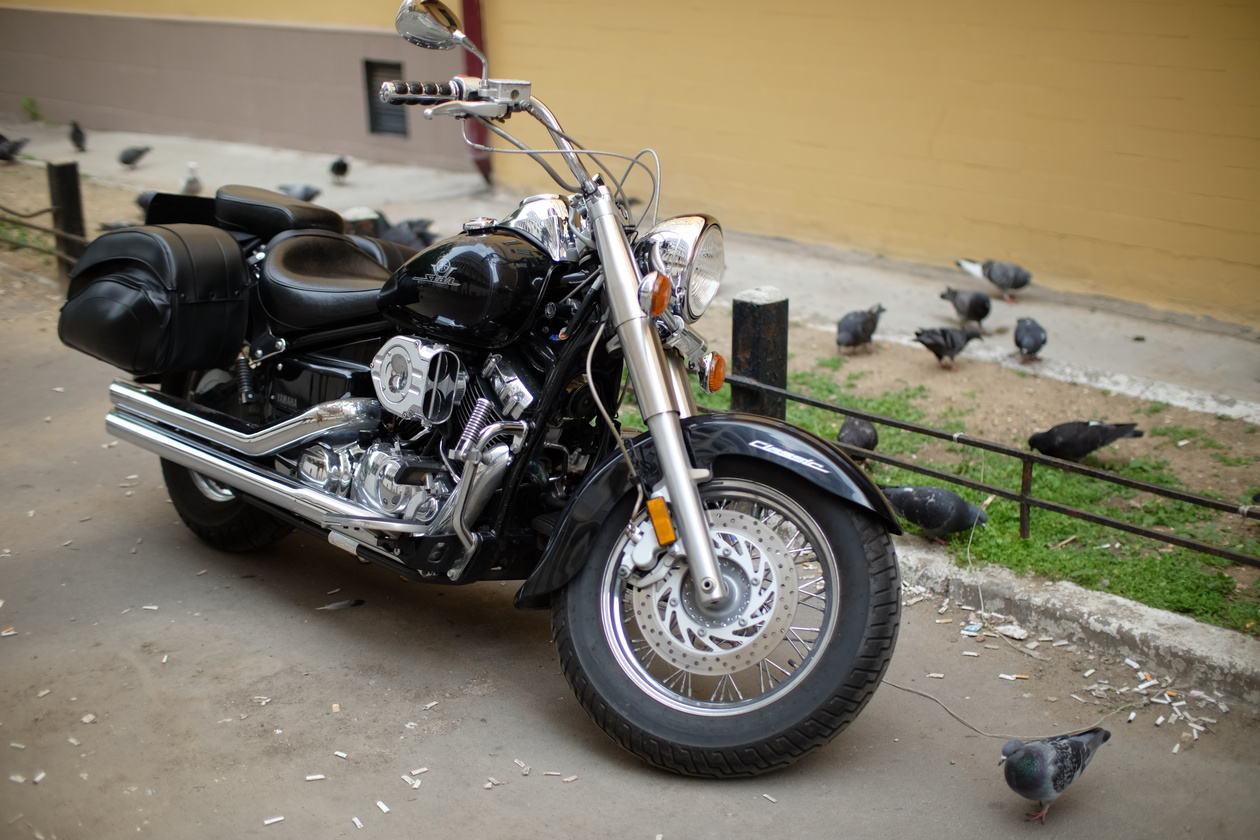
Chrome is this lens's weak spot. Do you like shiny chrome motorcycles? The reviewer's advice is not to shoot them with this lens wide open. The same goes for other subjects with bright details. Look closely and you will see plenty of chromatic aberration on the chrome parts. At f/4 it is minimal.
Geometric distortion is insignificant. The reviewer checked it on a frame of stone steps and paving: the first step and the tiles stay straight. For a manual 35mm used mostly in the near field, that means one less correction to think about.
Where to set it: f/0.95 to f/1.4 for portraits and low light. f/2 for a sharp center with soft edges. f/4 for clean edges and chrome. f/8 for peak sharpness.
How to get the most from it
The test results translate into five habits:
- Shoot portraits wide open, moving subjects stopped down. At f/0.95 a still subject is manageable, a moving one is a coin toss.
- Use your camera's focus aids. On the X-E2 in the test, the rangefinder-style aid and a magnified view on one button did the work of the missing autofocus.
- Work in the near field. Most of the focus throw sits between 0.35 and 3 m, where the rendering is most distinctive.
- Stop down to f/4 for edges and chrome. Edge softness, swirl and fringing on bright metal all fade by f/4.
- Check the filter thread. The review says 58 mm, the current maker's page says 55 mm.

Is the Mitakon 35mm f/0.95 Mark II worth buying?
Yes, if character matters more to you than correction. The reviewer spent a long time trying to understand this lens and its purpose. Primes near the "standard" focal length usually have an even, predictable rendering. The Mitakon turned out to be a dark horse. He took it to a summer street festival and to impromptu portrait sessions, and tried it in very different genres. Taming its big aperture is far from easy. Shooting it stopped down is less interesting, because there the differences between lenses fade.

Manual focus on the X-E2 proved comfortable. The lack of autofocus did not hurt picture quality or overall comfort. Kept wide open, the lens pulled the reviewer so deep into shooting that he nearly forgot to test its optics.
We are used to the idea that good optics must give a picture perfect in every respect. This lens is far from a textbook result, and that is exactly the attraction. Manual lenses, like manual aperture and shutter speed, take you back to a time when you had to know the strengths and weaknesses of your gear, work around them and rely on intuition. Good lenses are plentiful. Lenses that differ from the rest are rare.

The lens shows its best in low light and in portraits, where a creative approach pays off. It can also work as a plain "standard" lens with extra reach: stop down a few stops to avoid focus misses and clean up the corners, and it keeps pace with better-known, more expensive rivals. You can check current Mitakon Speedmaster 35mm f/0.95 listings. For another manual lens with a strong signature, see the Helios 40-2 85mm f/1.5, and for an ultra-fast manual wide-angle, the TTArtisan 21mm f/1.5.



Pros:
- usable f/0.95 in the near field;
- low price for the class;
- small size and weight;
- a unique rendering;
- a focal length that suits most genres;
- metal body;
- minimal distortion.
Cons:
- soft rendering, an acquired taste;
- very thick helicoid grease.
Frequently asked questions
- Is the Mitakon 35mm f/0.95 Mark II sharp wide open?
- In the center, yes, at portrait level. Focused at infinity on a Fujifilm X-E2, the center is good at f/0.95 and excellent from f/2, keeps improving to f/4 and peaks at f/8. The edges are a different story: from f/0.95 to f/2.8 they are clearly soft, with a slight swirl. Both effects disappear at f/4, and f/16 is still usable.
- How much does the Mitakon 35mm f/0.95 Mark II weigh?
- The tested Mark II weighs 460 g (16.2 oz) and measures 60 mm long by 63 mm across (2.4 by 2.5 in). The maker's launch note says that is 220 g lighter than the first version. The current product page lists a range of 390 to 460 g, so the weight may vary with the mount version you buy.
- Is the Mitakon 35mm f/0.95 an autofocus lens?
- No. It is fully manual, with a de-clicked aperture ring and depth of field and distance scales on the barrel. On the Fujifilm X-E2 in the test, the rangefinder-style focus aid and a one-button magnified view made manual focus pleasant for portraits. For moving subjects at f/0.95, the review recommends stopping down for more depth of field.
- Does the Mitakon 35mm f/0.95 work on full frame?
- It is designed for APS-C. The maker's FAQ says you can use it on a full-frame Sony E camera in APS-C mode, and warns of very heavy vignetting on a full-frame Canon body. On an APS-C camera it gives the view of a 52.5 mm lens on full frame, which the maker lists as a 43.5 degree angle of view.
- Is there a Mitakon 35mm f/0.95 Mark III?
- Not on the maker's own site. On November 23, 2026, the Zhong Yi Optics store listed the Mitakon Speedmaster 35mm f/0.95 as in stock and described it as the Mark II, and a site search for a Mark III returned only the 50mm f/0.95 III. The mount list has grown since the test: Nikon Z and Canon RF now appear next to Fuji X, Sony E and EOS-M.
Sources
- Mitakon Speedmaster 35mm f/0.95 product page, Zhong Yi Optics (2026)
- Version 2 of the Zhongyi Mitakon Speedmaster 35mm f/0.95 lens released, Zhong Yi Optics (2016)
- Circle of confusion, Wikipedia (2026)
- Depth of field, Wikipedia (2026)
Originally published on Prophotos.ru.