Camera sensor sizes, phone to medium format
by Editorial staff · Cameras, Photography Tips
As an Amazon Associate I earn from qualifying purchases. Links to Amazon on this page are affiliate links.
In short: A camera sensor size is the real width and height of the sensor in millimeters. Full frame is 36 x 24 mm, APS-C about 23.5 x 15.6 mm, Four Thirds about 18 x 13.5 mm and the 1-inch type 13.2 x 8.8 mm. Divide 43.3 mm, the full-frame diagonal, by a sensor's diagonal to get its crop factor.
What is sensor size? How does image quality depend on it? What do a 1-inch sensor, APS-C or full frame mean? And how is the crop factor connected to all of this? We explain the sizes of modern sensors in plain language, because this area is full of confusion. The full table of image sensor sizes is waiting for you further down the page.
What is full frame?
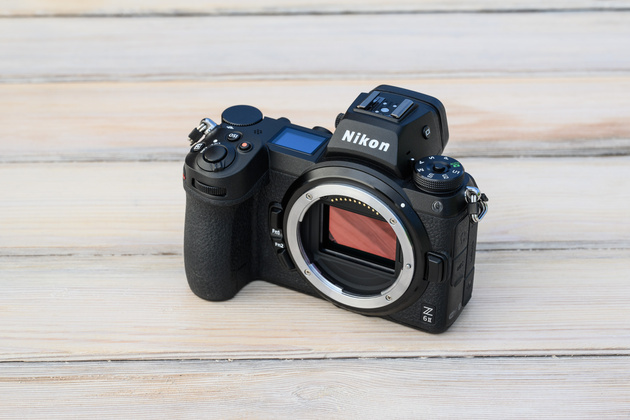
Let us start with the simplest idea, "full frame". It is also called 35 mm. It came to us from the film era and corresponds to the standard 24 x 36 mm frame used in the majority of film cameras, from classic SLRs to plastic point-and-shoots. Why 35 mm? Because that was the width of the film including the perforation. Here is an example of that very confusion in the names of frame formats.
What are crop factor and equivalent focal length?
Because it was so widespread, the 24 x 36 mm full frame became the reference point for the idea of the "crop factor". It all began when the first digital SLRs appeared. Making a 24 x 36 mm sensor for them turned out to be too expensive and too difficult at the time. Manufacturers took classic SLR cameras as the basis, kept their lens mount and lens compatibility, but fitted a smaller sensor. Because of this, lenses that photographers knew well began to behave differently on digital cameras. The frame was cut off at the edges, as it were, and lenses "zoomed in" more than on film cameras.
The ratio of the full-frame diagonal to the diagonal of the smaller sensor came to be called the crop factor. For photographers used to full-frame gear, it showed how much more their familiar lenses would "zoom in" on the new digital cameras. For example, a photographer shooting a Nikon D300s SLR with a 50 mm lens could multiply the x1.5 crop factor by the focal length of the lens and find out which full-frame lens his "fifty" corresponded to on a camera with a smaller sensor. This value became known as the equivalent focal length.
This is where the crop factor is of practical use. For photographers who had little experience with full-frame gear and went straight to digital cameras with a smaller sensor, the crop factor tells nothing useful.
Editor's note, the formulas. Every computed value in this article comes from three formulas, applied to the sensor dimensions in the table:
- Diagonal = √(width² + height²). For full frame, √(36² + 24²) = 43.27 mm.
- Crop factor = 43.27 mm ÷ the sensor's diagonal.
- Equivalent focal length = real focal length × crop factor. Equivalent aperture (for depth of field at the same framing) = f-number × crop factor.
The crop factor changes the framing and, at the same framing, the depth of field. It does not change exposure: f/2.8 at a given ISO and shutter speed gives the same brightness on every format. Our APS-C vs full frame comparison works through these numbers for the two most common camera formats.
APS-C sensors
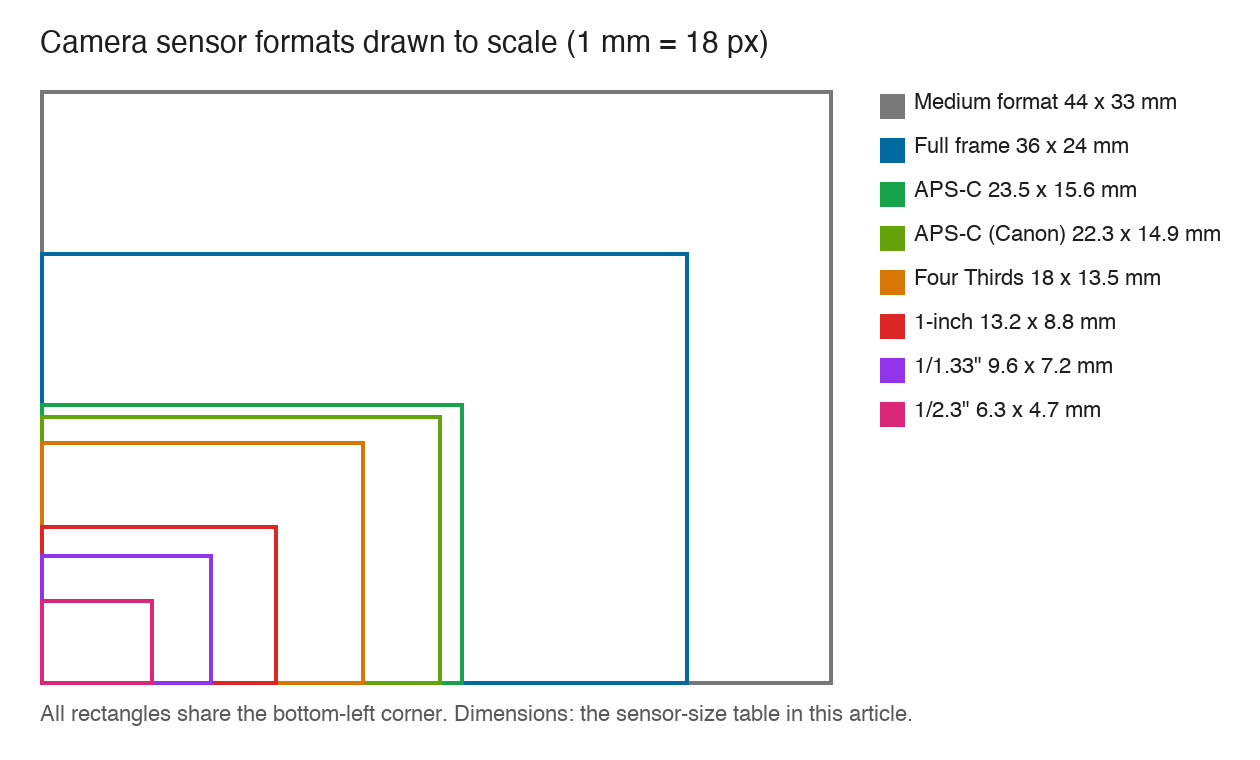
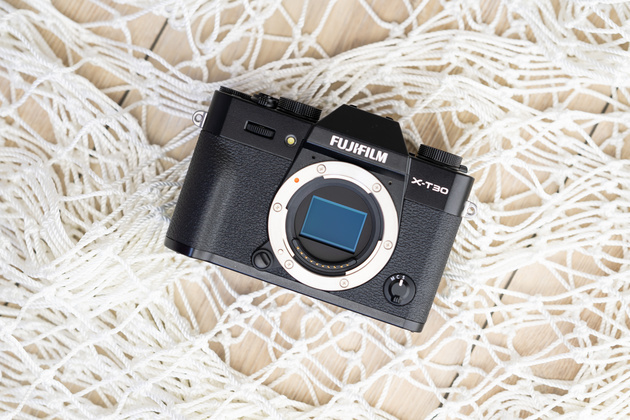
APS-C sensors are the most widespread format in enthusiast SLRs and mirrorless cameras. Such APS-C models are also called "cropped". APS-C sizes can vary slightly. In most cases, an APS-C sensor measures about 23.5 x 15.6 mm. Only in Canon cameras is it a little smaller: 22.3 x 14.9 mm.
Four Thirds, 1-inch, 1/2.3-inch and phone sensors
Small sensors are much cheaper to make than large ones. The same goes for lenses. And such systems are more compact. So APS-C was not where things stopped. Tiny sensors appeared, first for compact cameras and then for smartphones.
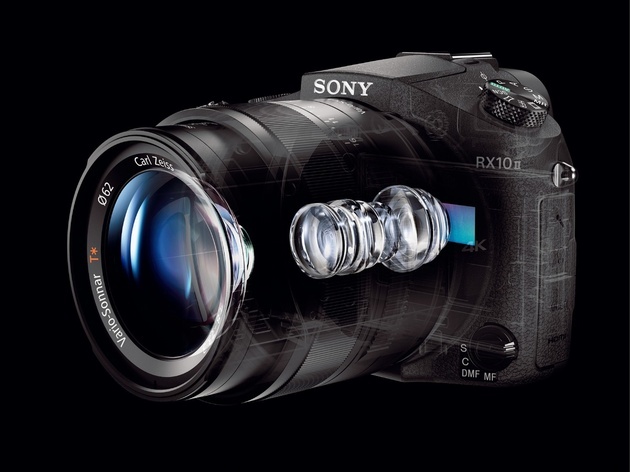
These frame formats were labeled... in fractions of an inch! And here lies the main catch. It looks something like this: 4/3", 1", 1/2", 1/2.33" and so on. The oddity is that this label has nothing to do with real inches. The stated size is not the diagonal of the frame at all. The label came to us from television, where it was used for the vidicon camera tube. There it gave the diameter of the tubes, not the size of the frame. Naturally, the frame itself was smaller than the tube's diameter. Hence the confusion.
So from here on we will call this label not the size but the format of the frame. Below is a summary table of real frame sizes in millimeters for all formats. Note, for example, that a sensor of the 1" format is much smaller than a real inch.
Sensor size chart
| Frame or sensor format | Real sensor size | Real frame diagonal |
|---|---|---|
| 1/3.6" | 4 x 3 mm | 5 mm |
| 1/3.2" | 4.6 x 3.4 mm | 5.7 mm |
| 1/3" | 4.8 x 3.6 mm | 6 mm |
| 1/2.7" | 5.3 x 4 mm | 6.6 mm |
| 1/2.3" | 6.3 x 4.7 mm | 7.8 mm |
| 1/2" | 6.4 x 4.8 mm | 8 mm |
| 1/1.8" | 7.2 x 5.3 mm | 8.9 mm |
| 1/1.7" | 7.6 x 5.7 mm | 9.5 mm |
| 2/3" | 8.8 x 6.6 mm | 11 mm |
| 1/1.33" | 9.6 x 7.2 mm | 12 mm |
| 1" (3:2) | 13.2 x 8.8 mm | 15.9 mm |
| 1" (4:3) | 13.1 x 9.8 mm | 15.9 mm |
| 4/3" | 18 x 13.5 mm | 22.5 mm |
| APS-C (Canon) | 22.3 x 14.9 mm | 26.8 mm |
| APS-C | 23.5 x 15.6 mm | 28.2 mm |
| Super35 | 24.9 x 18.7 mm | 31.1 mm |
| 35 mm (full frame) | 36 x 24 mm | 43.3 mm |
| Digital medium format | 44 x 33 mm | 55 mm |
Editor's note: the same formats, computed. Crop factor, area and equivalents below come from the formulas above, applied to the sizes in the first table.
| Format | Crop factor | Area vs full frame | 50 mm lens frames like | f/2.8 depth of field like |
|---|---|---|---|---|
| 1/3.6" | 8.65 | 1/72 | 433 mm | f/24 |
| 1/3.2" | 7.56 | 1/55 | 378 mm | f/21 |
| 1/3" | 7.21 | 1/50 | 361 mm | f/20 |
| 1/2.7" | 6.52 | 1/41 | 326 mm | f/18 |
| 1/2.3" | 5.50 | 1/29 | 275 mm | f/15 |
| 1/2" | 5.41 | 1/28 | 270 mm | f/15 |
| 1/1.8" | 4.84 | 1/23 | 242 mm | f/14 |
| 1/1.7" | 4.55 | 1/20 | 228 mm | f/13 |
| 2/3" | 3.93 | 1/15 | 197 mm | f/11 |
| 1/1.33" | 3.61 | 1/12.5 | 180 mm | f/10 |
| 1" (3:2) | 2.73 | 1/7.4 | 136 mm | f/7.6 |
| 1" (4:3) | 2.64 | 1/6.7 | 132 mm | f/7.4 |
| 4/3" | 1.92 | 1/3.6 | 96 mm | f/5.4 |
| APS-C (Canon) | 1.61 | 1/2.6 | 81 mm | f/4.5 |
| APS-C | 1.53 | 1/2.4 | 77 mm | f/4.3 |
| Super35 | 1.39 | 1/1.9 | 69 mm | f/3.9 |
| 35 mm (full frame) | 1.00 | 1 | 50 mm | f/2.8 |
| Digital medium format | 0.79 | 1.68x | 39 mm | f/2.2 |
Editor's note on the table. The crop factors come from the diagonals computed from width and height, so they differ slightly from the rounded values on camera spec sheets: APS-C works out to 1.53 rather than 1.5. For the 1" (4:3) row, 13.1 x 9.8 mm gives a diagonal of 16.4 mm, not the 15.9 mm in the first table; we kept that figure and computed the crop factor from the width and height. The last column describes depth of field at the same framing and distance. Exposure at f/2.8 stays the same on every format.
Rule of thumb: Each step down in format costs light-gathering area fast. APS-C has 1/2.4 of the full-frame area, Four Thirds about 1/3.6, a 1-inch sensor 1/7.4 and a 1/2.3-inch phone or compact sensor 1/29.
What is medium format?
This idea also came to us from the film era and goes back almost a hundred years. Back then, film with a 24 x 36 mm frame (that same 35 mm format) had only just come into wide use and was called "narrow". It was set against bulky large-format cameras, where the frame size could be measured in tens of centimeters and glass plates or sheet film served as the photographic material. Between them sat medium format, which has survived to this day as type 120 film.
The maximum frame height on such film was about 6 cm. The frame itself could be narrow (45 x 60 mm), square (6 x 6 cm) or wide (6 x 7 cm and more).
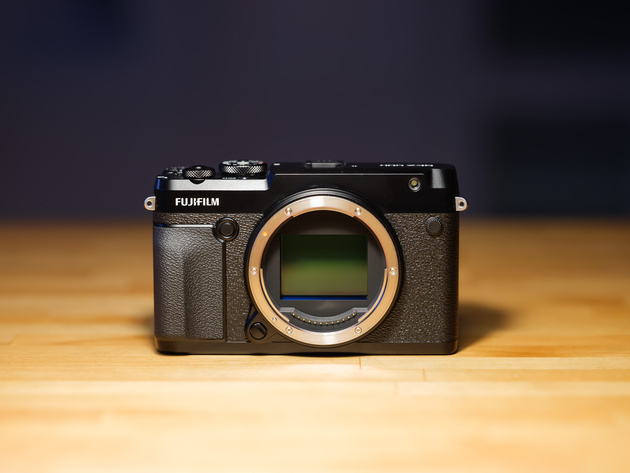
Unfortunately, for digital photography such a frame size is far too expensive. So digital medium format uses more compact sensors. The one exception is the expensive 100-megapixel Hasselblad H6D, with a 53.4 x 40 mm sensor. In the more affordable Fujifilm GFX and Hasselblad X medium format systems, the sensor measures about 44 x 33 mm.
Editor's note: medium format vs full frame in numbers. A 44 x 33 mm sensor has 1,452 mm² of area against 864 mm² for full frame, 1.68 times more. Its crop factor of 0.79 means a 50 mm lens frames like a 39 mm lens on full frame, and a 64 mm lens gives the classic 50 mm view (50 ÷ 0.79 = 63.6). The Hasselblad H6D's 53.4 x 40 mm sensor has 2,136 mm², 2.47 times the full-frame area.
Why does sensor size matter?
Sensor size largely determines image quality, because the size of each individual pixel depends on it. A smaller pixel catches fewer photons of light. In low light this becomes especially noticeable: digital noise appears and dynamic range shrinks. Of course, technology does not stand still. Modern sensors of the same size and resolution are far ahead of those made five and ten years ago. And smartphones have long used multi-frame capture and complex computational processing. But all else being equal, the larger sensor has the advantage.
That is exactly why professional reportage cameras are still made full frame, studios use medium format, and the 1" frame format has become the de facto standard for quality compacts.
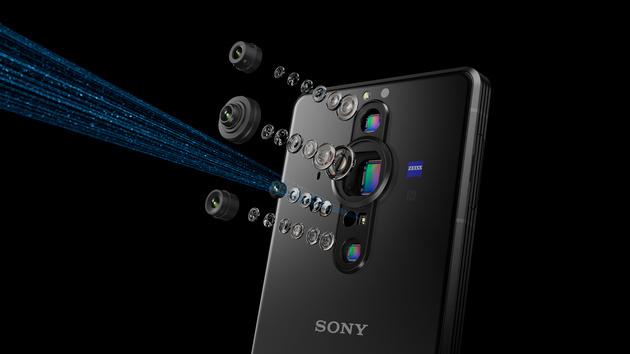
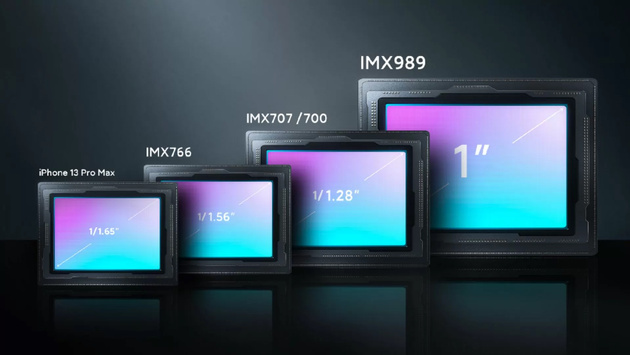
This also explains why smartphone makers are so reluctant to state the sensor sizes of their cameras. A 1/1.66" or 1/1.33" sensor format is unlikely to impress anyone. Those are exactly the sensors in the main cameras of flagships, and the additional cameras or budget models may use even smaller sensors. As of 2022, the exceptions could be counted on the fingers of one hand: the Xiaomi 12S Ultra, the Sony Xperia Pro-I and the Panasonic DMC-CM1 prototype.
So it is too early to write off classic cameras. Technical quality is still on their side.
Sensor sizes in current cameras (2026)
Editor's note. The formats in the table still define the current camera lines. We checked three current makers' spec pages in October 2026:
- Medium format: Fujifilm lists a 43.8 x 32.9 mm sensor for the GFX100 II and for the GFX100RF, the "about 44 x 33 mm" class above.
- APS-C: Fujifilm lists 23.5 x 15.7 mm for the X-T50, within 0.1 mm of the table's APS-C row.
- Four Thirds: OM System lists a 17.3 x 13.0 mm image area for the OM-1 Mark II. That is a little smaller than the table's 18 x 13.5 mm format size, and it gives the exact x2 crop factor (43.27 ÷ 21.64 = 2.00).
Sensor format names follow the video-tube convention described above, as the Wikipedia article on image sensor formats explains: a 1" type sensor has a diagonal of about 16 mm.
Which sensor size do you need?
Editor's note: our verdict. Pick the format by the light you shoot in and the size you can carry, in this order:
- Phone or 1/2.3-inch compact: fine in daylight. These sensors have 1/29 of the full-frame area, which shows as noise in dim rooms and at night.
- 1-inch compact: the quality step up for a pocket camera, with 7.4 times less area than full frame. Look at a 1-inch sensor compact camera if you want a pocketable camera that clearly beats a phone sensor.
- Four Thirds and APS-C: the interchangeable-lens middle ground with smaller, cheaper lenses. Choose between a Micro Four Thirds camera and an APS-C mirrorless camera by the lenses you want, since the area difference between them is a factor of 1.5.
- Full frame: the format professional reportage cameras still use, with 2.4 times the area of APS-C. A full-frame mirrorless camera suits low light, events and shallow depth of field.
- Medium format: 1.68 times the full-frame area, for studio, landscape and large prints, at the highest price of any format here.
If you are deciding between the two middle formats, read APS-C vs full frame. If the open question is the body type rather than the sensor, read mirrorless vs DSLR in 2026.
Frequently asked questions
- What are the common camera sensor sizes?
- From largest to smallest: digital medium format at about 44 x 33 mm, full frame at 36 x 24 mm, APS-C at 23.5 x 15.6 mm (22.3 x 14.9 mm in Canon cameras), Four Thirds at about 18 x 13.5 mm, the 1-inch type at 13.2 x 8.8 mm, and phone and compact formats such as 1/1.33-inch (9.6 x 7.2 mm) and 1/2.3-inch (6.3 x 4.7 mm).
- What is a medium format camera?
- A medium format camera uses a frame larger than the 36 x 24 mm full frame. On film this meant 120 roll film with frames such as 6 x 4.5, 6 x 6 and 6 x 7 cm. Digital medium format uses smaller sensors: Fujifilm lists 43.8 x 32.9 mm for its GFX100 II, and the sensor of the 100-megapixel Hasselblad H6D measures 53.4 x 40 mm.
- How much bigger is medium format than full frame?
- A 44 x 33 mm medium format sensor has 1,452 square millimeters of area against 864 for a 36 x 24 mm full-frame sensor, so it is about 1.68 times larger. Its crop factor is 0.79: a 50 mm lens on it frames like a 39 mm lens on full frame.
- What is Micro Four Thirds?
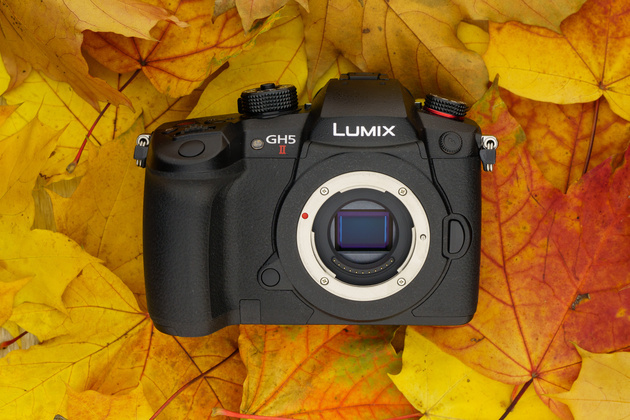
- Micro Four Thirds is a mirrorless camera system built around the Four Thirds sensor format, with a crop factor of 2. OM System lists a 17.3 x 13.0 mm image area for the OM-1 Mark II. A 25 mm lens on such a camera gives the angle of view of a 50 mm lens on full frame.
- Why is a 1-inch sensor not one inch across?
- Fractional-inch format names come from television camera tubes such as the vidicon, where the number gave the outer diameter of the tube rather than the size of the image. A 1-inch type sensor measures 13.2 x 8.8 mm with a diagonal of about 16 mm, well short of 25.4 mm.
- Does a bigger sensor give better image quality?
- All else being equal, yes. At the same resolution a larger sensor has larger pixels, and each pixel collects more light, so noise stays lower and dynamic range stays wider in dim light. Newer sensors and the multi-frame processing in phones narrow the gap, but they do not close it.
Sources
- Image sensor format, Wikipedia contributors (2026)
- Crop factor, Wikipedia contributors (2026)
- FUJIFILM GFX100 II specifications, Fujifilm (2026)
- FUJIFILM X-T50 specifications, Fujifilm (2026)
- OM-1 Mark II specifications, OM Digital Solutions (2026)
- Medium format, Wikipedia contributors (2026)
Originally published on Prophotos.ru.