Hyperfocal distance charts and a rule tested
by Piotr · Photography Tips
In short: The hyperfocal distance is the closest focus distance that keeps infinity sharp. Focus there, and everything from half that distance to infinity looks sharp. A 24 mm lens at f/8 on full frame: 2.52 m (8.3 ft), sharp from 1.26 m. The popular "one third" rules mostly fail the arithmetic. Depth of field splits one third in front only at one focus distance. Focusing one third into a deep scene costs about 1.5 stops of aperture.
Landscape photography has one focusing question: where do you focus so the rocks at your feet and the mountains both look sharp? The hyperfocal distance answers it with a number. The charts below give that number for seven focal lengths, four apertures and three sensor sizes. Then two rules of thumb meet the same arithmetic. One of them survives in a narrow case. The other survives in a narrower one.
What is hyperfocal distance
The hyperfocal distance is the closest focus distance at which the far limit of depth of field reaches infinity. Wikipedia's hyperfocal distance article states the payoff: focus there, and everything from half that distance out to infinity is acceptably sharp. That half-distance near limit is the reason the technique exists. No other focus point gives a nearer sharp foreground while keeping infinity.
The formula:
H = f² ÷ (N × c) + f
Here f is the focal length, N the f-number and c the circle of confusion. On this site c is the sensor diagonal divided by 1500, the convention in Wikipedia's circle of confusion article. Searches for "hyperfocal length" usually mean this same distance.
Two things follow from the formula. Hyperfocal distance grows with the square of focal length: double the focal length, and H roughly quadruples. And it falls in proportion to the f-number: double the f-number, and H roughly halves.
Hyperfocal distance charts
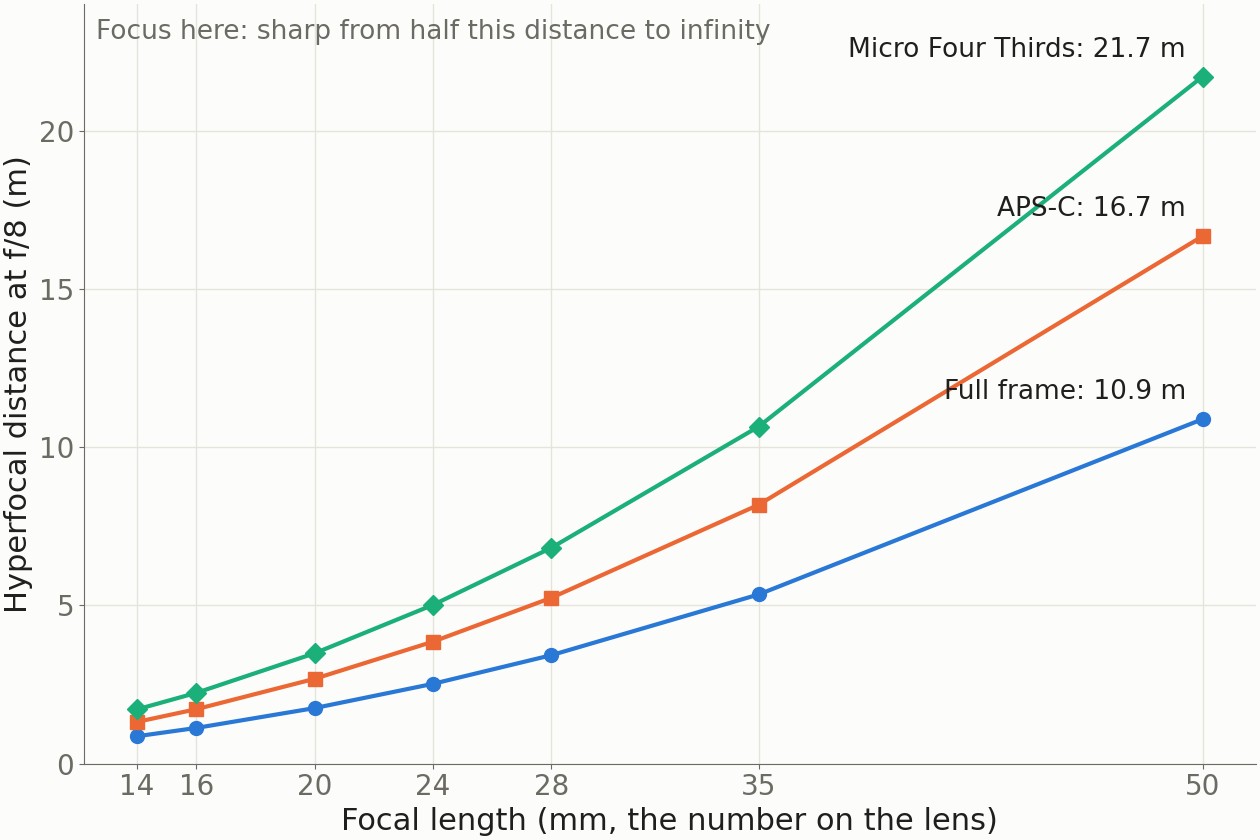
Focus at the distance in the cell. The near limit of sharpness is half of it. Distances run from the sensor plane. Print the table for your format and keep it in the bag.
Full frame (circle of confusion 0.0288 mm):
| Focal length | f/5.6 | f/8 | f/11 | f/16 |
|---|---|---|---|---|
| 14 mm | 1.2 m (4.0 ft) | 0.9 m (2.8 ft) | 0.6 m (2.1 ft) | 0.4 m (1.4 ft) |
| 16 mm | 1.6 m (5.3 ft) | 1.1 m (3.7 ft) | 0.8 m (2.7 ft) | 0.6 m (1.9 ft) |
| 20 mm | 2.5 m (8.2 ft) | 1.8 m (5.8 ft) | 1.3 m (4.2 ft) | 0.9 m (2.9 ft) |
| 24 mm | 3.6 m (12 ft) | 2.5 m (8.3 ft) | 1.8 m (6.0 ft) | 1.3 m (4.2 ft) |
| 28 mm | 4.9 m (16 ft) | 3.4 m (11 ft) | 2.5 m (8.2 ft) | 1.7 m (5.7 ft) |
| 35 mm | 7.6 m (25 ft) | 5.3 m (18 ft) | 3.9 m (13 ft) | 2.7 m (8.8 ft) |
| 50 mm | 16 m (51 ft) | 11 m (36 ft) | 7.9 m (26 ft) | 5.5 m (18 ft) |
APS-C, 23.5 x 15.6 mm (circle of confusion 0.0188 mm):
| Focal length | f/5.6 | f/8 | f/11 | f/16 |
|---|---|---|---|---|
| 14 mm | 1.9 m (6.2 ft) | 1.3 m (4.3 ft) | 1.0 m (3.2 ft) | 0.7 m (2.2 ft) |
| 16 mm | 2.4 m (8.0 ft) | 1.7 m (5.6 ft) | 1.3 m (4.1 ft) | 0.9 m (2.8 ft) |
| 20 mm | 3.8 m (13 ft) | 2.7 m (8.8 ft) | 2.0 m (6.4 ft) | 1.3 m (4.4 ft) |
| 24 mm | 5.5 m (18 ft) | 3.9 m (13 ft) | 2.8 m (9.2 ft) | 1.9 m (6.4 ft) |
| 28 mm | 7.5 m (25 ft) | 5.2 m (17 ft) | 3.8 m (13 ft) | 2.6 m (8.6 ft) |
| 35 mm | 12 m (38 ft) | 8.2 m (27 ft) | 6.0 m (20 ft) | 4.1 m (13 ft) |
| 50 mm | 24 m (78 ft) | 17 m (55 ft) | 12 m (40 ft) | 8.4 m (27 ft) |
Micro Four Thirds (circle of confusion 0.0144 mm):
| Focal length | f/5.6 | f/8 | f/11 | f/16 |
|---|---|---|---|---|
| 14 mm | 2.4 m (8.0 ft) | 1.7 m (5.6 ft) | 1.2 m (4.1 ft) | 0.9 m (2.8 ft) |
| 16 mm | 3.2 m (10 ft) | 2.2 m (7.3 ft) | 1.6 m (5.3 ft) | 1.1 m (3.7 ft) |
| 20 mm | 5.0 m (16 ft) | 3.5 m (11 ft) | 2.5 m (8.3 ft) | 1.8 m (5.8 ft) |
| 24 mm | 7.2 m (23 ft) | 5.0 m (16 ft) | 3.7 m (12 ft) | 2.5 m (8.3 ft) |
| 28 mm | 9.7 m (32 ft) | 6.8 m (22 ft) | 5.0 m (16 ft) | 3.4 m (11 ft) |
| 35 mm | 15 m (50 ft) | 11 m (35 ft) | 7.8 m (25 ft) | 5.3 m (18 ft) |
| 50 mm | 31 m (102 ft) | 22 m (71 ft) | 16 m (52 ft) | 11 m (36 ft) |
The tables use the focal length printed on the lens. A 24 mm lens on Micro Four Thirds reaches twice as far as on full frame, because the smaller format demands a smaller blur disc. It also frames like a 48 mm lens on full frame, so compare formats by framing, not by the number on the barrel.
At the same framing, a smaller sensor focuses closer
Match the framing and the order flips. A 24 mm view on full frame takes 15.6 mm on APS-C and 12 mm on Micro Four Thirds. At f/8, their hyperfocal distances are 2.52 m, 1.64 m and 1.26 m. The smaller sensor holds a nearer foreground with infinity, at the same f-number. That is the same arithmetic that makes full frame blur more in portraits. The depth of field guide tests that claim, and the wide-angle lens guide covers the lenses these charts serve.
The "one third" rule, tested twice
Two different rules travel under the same name. Both get the numbers here.
Rule 1: depth of field extends one third in front of the focus point and two thirds behind.
The share in front depends on where you focus relative to the hyperfocal distance. With H much larger than f, the share in front is (H − s) ÷ 2H. It equals one third at one point only: s = H ÷ 3. The table uses a 24 mm lens at f/8 on full frame (H = 2.52 m).
| Focus distance | Share of H | Near limit | Far limit | Share of depth in front |
|---|---|---|---|---|
| 0.25 m | 10% | 0.23 m | 0.28 m | 45.4% |
| 0.50 m | 20% | 0.42 m | 0.62 m | 40.4% |
| 0.84 m | 33% | 0.63 m | 1.25 m | 33.7% |
| 1.26 m | 50% | 0.84 m | 2.50 m | 25.2% |
| 1.89 m | 75% | 1.08 m | 7.49 m | 12.6% |
| 2.27 m | 90% | 1.19 m | 22.47 m | 5.0% |
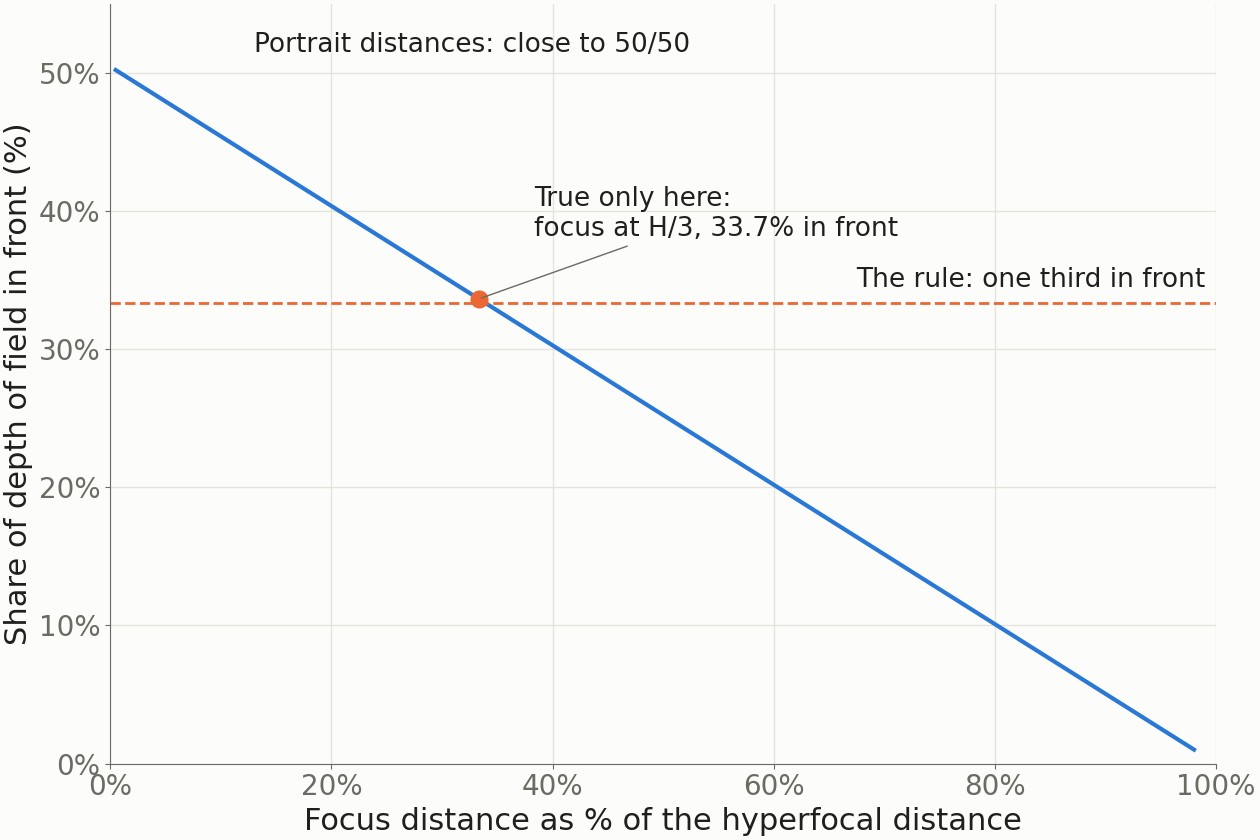
At portrait distances the split is close to half and half. An 85 mm lens at f/1.8 focused at 2 m puts 49.3% of its depth in front. Wikipedia's depth of field article says the same in words. The ratio nears 1:1 at typical portrait distances and becomes 1:∞ at the hyperfocal distance.
Rule 2: focus one third of the way into the scene.
For a scene that runs to infinity, a third of the way in has no meaning. So the test uses scenes with a far end. For a scene from a near point A to a far point B, the focus that needs the smallest f-number sits at 2AB ÷ (A + B). That formula is from the same Wikipedia article. The table compares it with the one third point, A + (B − A) ÷ 3.
| Scene, near to far | Lens | Best focus | f-number needed | One third point | f-number needed | Cost of the rule |
|---|---|---|---|---|---|---|
| 1 m to 10 m | Full frame, 24 mm | 1.82 m | f/9.1 | 4.00 m | f/15.1 | 1.45 stops |
| 1 m to 10 m | APS-C, 16 mm | 1.82 m | f/6.2 | 4.00 m | f/10.3 | 1.46 stops |
| 3 m to 30 m | Full frame, 35 mm | 5.45 m | f/6.4 | 12.00 m | f/10.6 | 1.46 stops |
| 1 m to 100 m | Full frame, 24 mm | 1.98 m | f/10.0 | 34.00 m | f/19.4 | 1.91 stops |
| 2 m to 6 m | Full frame, 24 mm | 3.00 m | f/3.4 | 3.33 m | f/4.0 | 0.52 stops |
| 2 m to 4 m | Full frame, 50 mm | 2.67 m | f/11.0 | 2.67 m | f/11.0 | 0 stops |
Verdict: Rule 1 holds at exactly one focus distance, a third of the hyperfocal distance. Rule 2 matches the best focus point only when the far end is twice the near end. The 2 m to 4 m row is that case. For a typical landscape, focusing a third of the way in costs about 1.5 stops. That means f/16 where f/9 would do, with more diffraction and a longer shutter speed.
A better field rule
The best focus point always sits much closer than a third of the way in. For a scene that runs to infinity, it sits at twice the distance of the nearest thing you want sharp. That is the hyperfocal distance itself, chosen so that half of it falls on your foreground.
- Find the nearest thing that must be sharp. Pace it out or estimate it. Call it A.
- Double it. That is your target hyperfocal distance.
- Find the widest aperture whose chart value is at or under 2A. With a 24 mm lens on full frame and a rock at 1.3 m, the target is 2.6 m. The chart gives 2.5 m at f/8.
- Focus at the chart value, not at infinity. Focus on an object at that distance, then switch to manual focus so the camera does not refocus.
- Check the far edge at full magnification. The chart assumes a standard print size. Large prints need a stricter limit, explained on the depth of field calculator page.
For a scene with a near end and a far end, focus at 2AB ÷ (A + B) instead. A scene from 1 m to 10 m gives 1.82 m. Then stop down until the calculator shows both ends inside the zone.
Hyperfocal distance calculator
The calculator below opens on the chart's full-frame 24 mm at f/8, focused at 2.53 m, just past the 2.52 m hyperfocal distance. Change any value and the hyperfocal distance updates.
Depth of field calculator
- Near limit
- 1.26 m
- Far limit
- infinity
- Total depth
- infinity
- Hyperfocal
- 2.52 m
Circle of confusion 0.0288 mm (sensor diagonal / 1500). Thin-lens model, distance measured from the sensor. Focus at the hyperfocal distance and everything from half that distance to infinity is acceptably sharp.
Set the distance a little short of the hyperfocal value and watch the far limit. At 2.4 m it drops from infinity to 49.9 m. Focusing slightly past the hyperfocal distance is the safer error. At 2.6 m the near limit moves out 2 cm, from 1.26 m to 1.28 m, and infinity stays sharp.
How the numbers were computed
- Hyperfocal distance: H = f² ÷ (N × c) + f, with c = sensor diagonal ÷ 1500. Full frame 0.0288 mm, APS-C 0.0188 mm, Micro Four Thirds 0.0144 mm. Micro Four Thirds uses the 17.3 x 13.0 mm imaging area listed by Wikipedia.
- Near and far limits: near = s × (H − f) ÷ (H + s − 2f); far = s × (H − f) ÷ (H − s).
- Share in front: (s − near) ÷ (far − near).
- f-number needed: the smallest f-number that puts the near limit at or inside A and the far limit at or beyond B. A bisection on the formulas above finds it. Cost in stops = 2 × log base 2 of the f-number ratio, since each stop multiplies the f-number by the square root of 2.
- Chart cells: rounded to 0.1 m below 10 m and to 1 m above; feet are converted from the unrounded value.
Frequently asked questions
- What is hyperfocal distance?
- The hyperfocal distance is the closest focus distance that keeps infinity acceptably sharp. Focus there, and everything from half that distance to infinity looks sharp. It depends on the focal length, the aperture and the sensor size. A 24 mm lens at f/8 on full frame has a hyperfocal distance of 2.52 m, so the sharp zone starts at 1.26 m.
- How do you calculate hyperfocal distance?
- Use H = f² ÷ (N × c) + f. Here f is the focal length in millimeters, N the f-number and c the circle of confusion, the sensor diagonal divided by 1500. For 24 mm at f/8 on full frame: 576 ÷ (8 × 0.02884) + 24 = 2,520 mm, or 2.52 m. The calculator on this page does the same arithmetic.
- Is it true that depth of field extends one third in front and two thirds behind?
- Only at one focus distance: a third of the hyperfocal distance. At portrait distances the split is close to half and half. An 85 mm lens at f/1.8 focused at 2 m puts 49.3% of its depth of field in front. Focused at half the hyperfocal distance, the split is one quarter in front and three quarters behind.
- Should you focus one third into the scene?
- Not for deep scenes. For a scene from 1 m to 10 m with a 24 mm lens on full frame, the one third point is 4 m. Focusing there needs f/15.1 to cover the scene. Focusing at 1.82 m needs only f/9.1, about 1.5 stops wider. The rule only matches the best focus point when the far end is twice the near end.
- Why does a smaller sensor have a shorter hyperfocal distance?
- At the same framing, a smaller sensor uses a shorter lens, and hyperfocal distance falls with the square of focal length. The smaller circle of confusion only partly offsets that. Frame like a 24 mm lens on full frame and set f/8. The hyperfocal distance is 2.52 m on full frame, 1.64 m on APS-C and 1.26 m on Micro Four Thirds.
Sources
- Hyperfocal distance, Wikipedia (2026)
- Depth of field (near:far distribution; focus from DOF limits), Wikipedia (2026)
- Circle of confusion, Wikipedia (2026)
- Micro Four Thirds system, Wikipedia (2026)