Depth of field explained with computed tables
by Piotr · Photography Tips
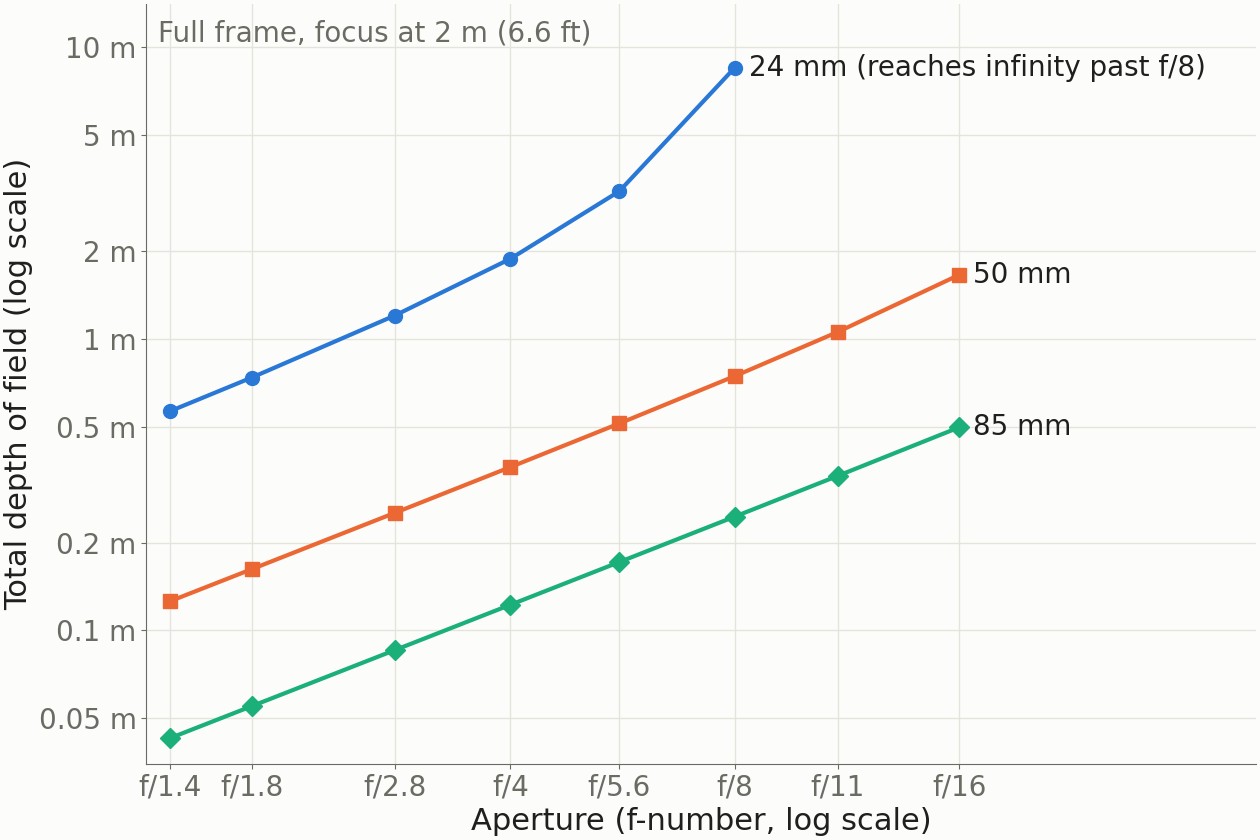
In short: Depth of field is the zone in front of and behind your focus point that looks acceptably sharp. Three things set it: aperture, focus distance and focal length. A 50 mm lens on full frame, focused at 2 m, holds 16 cm sharp at f/1.8 and 1.65 m at f/16. The claim that full frame gives shallower depth of field is half true. The half that holds is about f-numbers, not sensors.
Aperture has two jobs, and the second one causes the trouble. The first is brightness. The second is depth of field: the slab of the scene, in front of and behind your focus point, that looks sharp. Open the aperture and the slab gets thinner. Step closer and it thins again. Zoom in from the same spot and it thins a third time. That is the whole mechanism. The rest is arithmetic, and the tables below do it for you.
What is depth of field
Depth of field is the distance between the nearest and the farthest points that look acceptably sharp. A lens focuses perfectly on one plane only. Points in front of it and behind it render as small discs instead of points. While a disc stays smaller than a set limit, your eye reads it as a point. That limit is the circle of confusion.
The usual limit is the sensor diagonal divided by 1500, according to Wikipedia's circle of confusion article. On full frame, with its 43.27 mm diagonal, that is 0.029 mm. It assumes a print about 30 cm (12 in) across the diagonal, viewed from about 25 cm (10 in). Print bigger and view from the same spot, and the limit shrinks. The depth of field calculator page shows what that does to the numbers.
So the correct way to read depth of field: a convention with a ruler attached. It is not a physical edge in the scene. Sharpness fades on both sides; the limits mark where the fade becomes visible.
Shallow vs deep depth of field
Shallow depth of field is a thin sharp slab. A face stays sharp and the background melts. Deep depth of field is a long slab. Rocks at your feet and mountains on the horizon both stay sharp. The same physics produces both. Only the settings differ.
| Shallow depth of field | Deep depth of field | |
|---|---|---|
| Example setting (full frame, focus 2 m) | 85 mm at f/1.8 | 24 mm at f/11 |
| Sharp zone | 1.97 m to 2.03 m (6 cm) | 0.96 m to infinity |
| Aperture | Wide (small f-number) | Small (large f-number) |
| Focal length from the same spot | Long | Short |
| Typical use | Portraits, products, details | Landscapes, interiors, groups |
| Page with the method | Shallow depth of field | Hyperfocal distance |
How aperture affects depth of field
Depth of field grows almost in step with the f-number. Two stops, from f/2.8 to f/5.6, double the f-number. With a 50 mm lens at 2 m, the sharp zone grows from 25 cm to 51 cm, a factor of 2.02. The aperture and f-stops guide explains the f-number scale itself. Each full stop multiplies the f-number by the square root of 2, per Wikipedia's f-number article.
The proportion breaks down as you approach the hyperfocal distance. There, the far limit runs away and then jumps to infinity. The 24 mm column in the tables shows it.
Depth of field tables for 24, 50 and 85 mm
Both tables use a full-frame sensor. Each cell gives the total sharp zone, then the near and far limits in parentheses.
Focus at 2 m (6.6 ft):
| Aperture | 24 mm | 50 mm | 85 mm |
|---|---|---|---|
| f/1.8 | 0.74 m (1.70 to 2.43 m) | 0.16 m (1.92 to 2.08 m) | 0.06 m (1.97 to 2.03 m) |
| f/2.8 | 1.20 m (1.57 to 2.77 m) | 0.25 m (1.88 to 2.13 m) | 0.09 m (1.96 to 2.04 m) |
| f/4 | 1.88 m (1.43 to 3.31 m) | 0.36 m (1.83 to 2.20 m) | 0.12 m (1.94 to 2.06 m) |
| f/5.6 | 3.20 m (1.29 to 4.49 m) | 0.51 m (1.78 to 2.29 m) | 0.17 m (1.92 to 2.09 m) |
| f/8 | 8.48 m (1.12 to 9.60 m) | 0.74 m (1.69 to 2.44 m) | 0.25 m (1.88 to 2.13 m) |
| f/11 | infinity (0.96 m to infinity) | 1.05 m (1.60 to 2.66 m) | 0.34 m (1.84 to 2.18 m) |
| f/16 | infinity (0.77 m to infinity) | 1.65 m (1.47 to 3.12 m) | 0.50 m (1.78 to 2.28 m) |
Focus at 5 m (16 ft):
| Aperture | 24 mm | 50 mm | 85 mm |
|---|---|---|---|
| f/1.8 | 5.61 m (3.45 to 9.07 m) | 1.04 m (4.53 to 5.57 m) | 0.35 m (4.83 to 5.18 m) |
| f/2.8 | 13.6 m (2.95 to 16.5 m) | 1.64 m (4.31 to 5.95 m) | 0.55 m (4.74 to 5.29 m) |
| f/4 | 1,529 m (2.50 to 1,531 m) | 2.41 m (4.07 to 6.48 m) | 0.79 m (4.64 to 5.43 m) |
| f/5.6 | infinity (2.09 m to infinity) | 3.56 m (3.79 to 7.35 m) | 1.11 m (4.50 to 5.62 m) |
| f/8 | infinity (1.67 m to infinity) | 5.77 m (3.43 to 9.21 m) | 1.61 m (4.32 to 5.93 m) |
| f/11 | infinity (1.34 m to infinity) | 10.4 m (3.07 to 13.4 m) | 2.26 m (4.11 to 6.38 m) |
| f/16 | infinity (1.00 m to infinity) | 55.4 m (2.61 to 58.0 m) | 3.48 m (3.81 to 7.29 m) |
Look at 24 mm at f/4 and 5 m. The far limit sits at 1,531 m. The hyperfocal distance for that setting is 5.02 m, so 5 m focus sits just short of it. One step further and the far limit is infinity. That cell is a warning about precision. Near the hyperfocal distance, a few centimeters of focus error move the far limit by kilometers.
The three levers in one line
Well short of the hyperfocal distance, the exact formulas shrink to a simple approximation:
Total depth of field ≈ 2 × N × c × s² ÷ f²
Here N is the f-number, c the circle of confusion, s the focus distance and f the focal length. The tables confirm each term:
- Aperture, linear. f/2.8 to f/5.6 at 2 m with 50 mm: 2.02 times deeper.
- Distance, squared. 2 m to 4 m at f/2.8 with 50 mm: 4.10 times deeper.
- Focal length, inverse square. 50 mm against 85 mm at 2 m and f/2.8: 2.95 times deeper. The square of 85/50 is 2.89.
Distance is the biggest lever you control without buying anything. Halving the distance cuts the zone to about a quarter.
The full-frame myth, tested
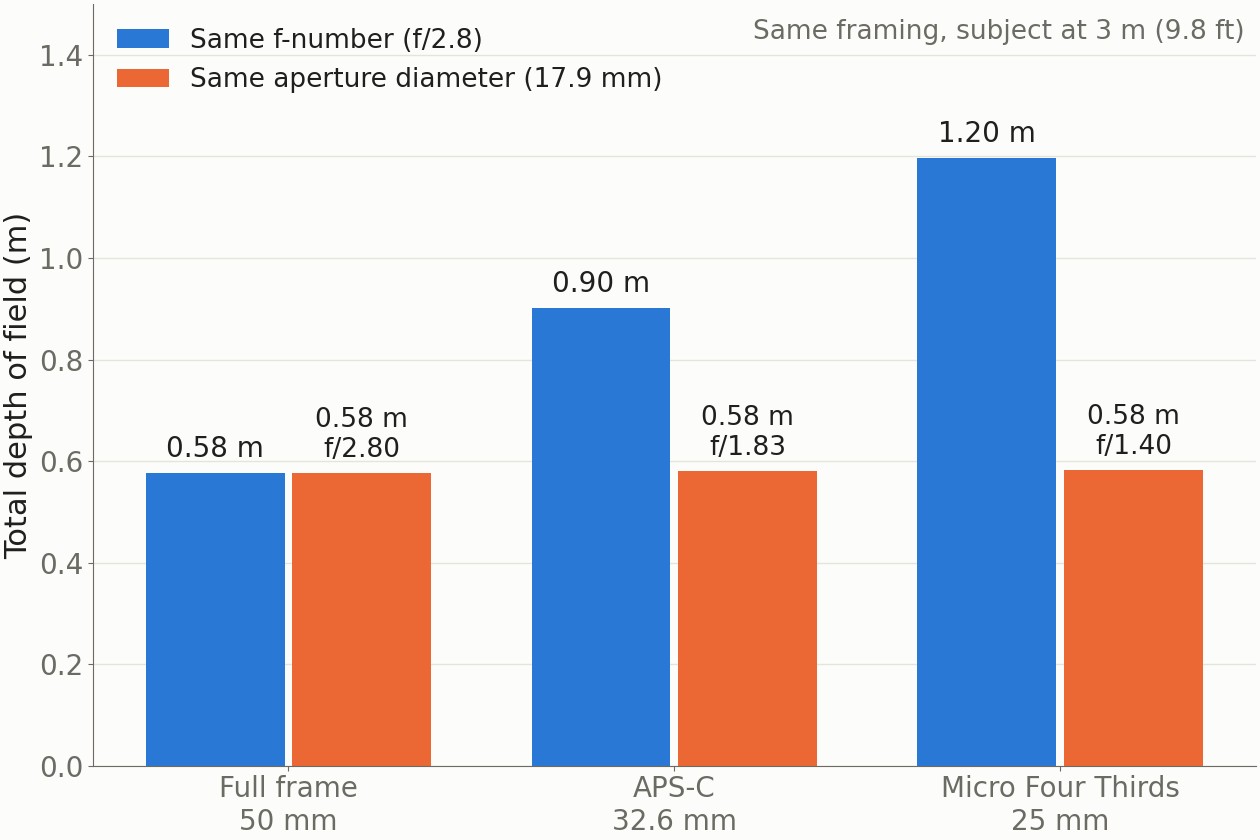
The claim: "full frame gives shallower depth of field." Here is the test. Each format frames the same scene from the same spot, so each uses its own focal length. Full frame uses 50 mm, APS-C 32.6 mm, Micro Four Thirds 25 mm. Then two comparisons follow. First, all three use the same f-number. Second, all three use the same aperture diameter in millimeters.
| Scene (same framing) | Full frame | APS-C | Micro Four Thirds |
|---|---|---|---|
| Portrait, 85 mm equivalent, 2 m, same f/1.8 | 5.5 cm | 8.6 cm | 11.3 cm |
| Same portrait, same aperture diameter (47.2 mm) | 5.5 cm at f/1.8 | 5.6 cm at f/1.17 | 5.6 cm at f/0.90 |
| Walkaround, 50 mm equivalent, 3 m, same f/2.8 | 57.7 cm | 90.2 cm | 119.7 cm |
| Same scene, same aperture diameter (17.9 mm) | 57.7 cm at f/2.8 | 58.1 cm at f/1.83 | 58.2 cm at f/1.40 |
| Landscape, 24 mm equivalent, 5 m, same f/8 | 1.67 m to infinity | 1.23 m to infinity | 1.00 m to infinity |
Verdict: half true. At the same f-number and framing, full frame is shallower by about the crop factor: 1.5 times against APS-C, 2 times against Micro Four Thirds. At the same aperture diameter, the formats agree to within about 2%. The sensor does nothing on its own. The only thing it changes is the focal length you need. The bigger format simply needs a longer lens, and a longer lens at the same f-number has a wider opening.
The practical half matters most for portraits. Matching an 85 mm f/1.8 on full frame takes f/0.90 on Micro Four Thirds. Check whether your lens catalogue lists an f/0.9 at that focal length. For landscapes, the myth is irrelevant. All three formats reach infinity in the last row. The smaller sensor even holds a nearer foreground sharp. The APS-C vs full frame comparison covers the rest of the trade, and camera sensor sizes explained lists the formats.
Try your own numbers
The calculator below uses the same formulas as every table on this page. It opens on the walkaround case from the myth test: full frame, 50 mm, f/2.8, 3 m.
Depth of field calculator
- Near limit
- 2.74 m
- Far limit
- 3.32 m
- Total depth
- 0.58 m
- Hyperfocal
- 31.0 m
Circle of confusion 0.0288 mm (sensor diagonal / 1500). Thin-lens model, distance measured from the sensor. Focus at the hyperfocal distance and everything from half that distance to infinity is acceptably sharp.
Change the sensor to APS-C and the focal length to 33. The total grows from 0.58 m to 0.88 m. Now set f/1.8: it falls to 0.56 m, next to the full-frame 0.58 m. That is the myth test, repeated by hand. The depth of field calculator page has worked examples and the formulas in full.
How the numbers were computed
Every table and chart here comes from one thin-lens model, the same one inside the calculator. Distances run from the sensor plane.
- Circle of confusion: c = sensor diagonal ÷ 1500. Full frame (36 x 24 mm): 0.0288 mm. APS-C (23.5 x 15.6 mm): 0.0188 mm. Micro Four Thirds: 0.0144 mm, using the 17.3 x 13.0 mm imaging area listed by Wikipedia.
- Hyperfocal distance: H = f² ÷ (N × c) + f.
- Near limit: s × (H − f) ÷ (H + s − 2f). Far limit: s × (H − f) ÷ (H − s), and infinity once s reaches H.
- Same framing: focal length = full-frame focal length ÷ crop factor. The crop factor is the ratio of diagonals: 1.53 for APS-C, 2.00 for Micro Four Thirds.
- Same aperture diameter: diameter = focal length ÷ f-number, the definition of the f-number.
These are the formulas in Wikipedia's depth of field article and hyperfocal distance article. Real lenses with focus breathing will differ a little at close range. The hyperfocal distance page prints the charts for landscape focal lengths.
Frequently asked questions
- What is depth of field in photography?
- Depth of field is the zone in front of and behind your focus point that still looks acceptably sharp. Aperture, focus distance and focal length set its size. Take a 50 mm lens on full frame focused at 2 m. The zone is 16 cm deep at f/1.8 and 1.65 m deep at f/16. Everything outside the zone blurs gradually.
- What is deep depth of field?
- Deep depth of field means a long sharp zone, from near the camera to far away. Landscape and architecture photographers use it. It comes from a short focal length, a small aperture and a focus point that is not too close. A 24 mm lens on full frame at f/11, focused at 2 m, is sharp from 0.96 m to infinity.
- What is the difference between shallow and deep depth of field?
- Only the length of the sharp zone. Shallow depth of field keeps a thin slice sharp and blurs the rest, which isolates a face or a product. Deep depth of field keeps the whole scene sharp. On full frame at 2 m, an 85 mm lens at f/1.8 holds 6 cm sharp. A 24 mm lens at f/11 holds everything from 0.96 m outward.
- How does aperture affect depth of field?
- Closing the aperture lengthens the depth of field almost in proportion to the f-number. Two stops, from f/2.8 to f/5.6, double the f-number, and the depth of field doubles with it. With a 50 mm lens on full frame at 2 m, it grows from 25 cm to 51 cm. Near the hyperfocal distance, it grows faster and then reaches infinity.
- Does full frame have a shallower depth of field than APS-C?
- At the same f-number and the same framing, yes. Frame a 50 mm view at f/2.8 from 3 m. Full frame holds 58 cm sharp, APS-C 90 cm and Micro Four Thirds 120 cm. Match the aperture diameter instead, with f/1.83 on APS-C and f/1.4 on Micro Four Thirds, and all three hold 58 cm.
- Does focal length change depth of field?
- From the same spot, yes, and strongly. At 2 m and f/2.8 on full frame, a 50 mm lens holds 25 cm sharp and an 85 mm lens holds 9 cm. Step back to 3.4 m with the 85 mm to keep the subject the same size, and it holds 25 cm too. The longer lens still blurs a distant background more, because its aperture opening is wider: 30.4 mm against 17.9 mm.
Sources
- Depth of field, Wikipedia (2026)
- Circle of confusion, Wikipedia (2026)
- Hyperfocal distance, Wikipedia (2026)
- F-number, Wikipedia (2026)
- Micro Four Thirds system, Wikipedia (2026)