How to get a shallow depth of field
by Piotr · Photography Tips
As an Amazon Associate I earn from qualifying purchases. Links to Amazon on this page are affiliate links.
In short: A shallow depth of field keeps a thin slice sharp and blurs the rest. Five levers make the blur bigger. The main one is framing: fill the frame. Then open the aperture and use a bigger sensor at the same f-number. Then use a longer lens and step back. Last, move the subject away from the background. At the same framing, the single number that predicts most of the blur is the aperture diameter in millimeters, focal length divided by f-number.
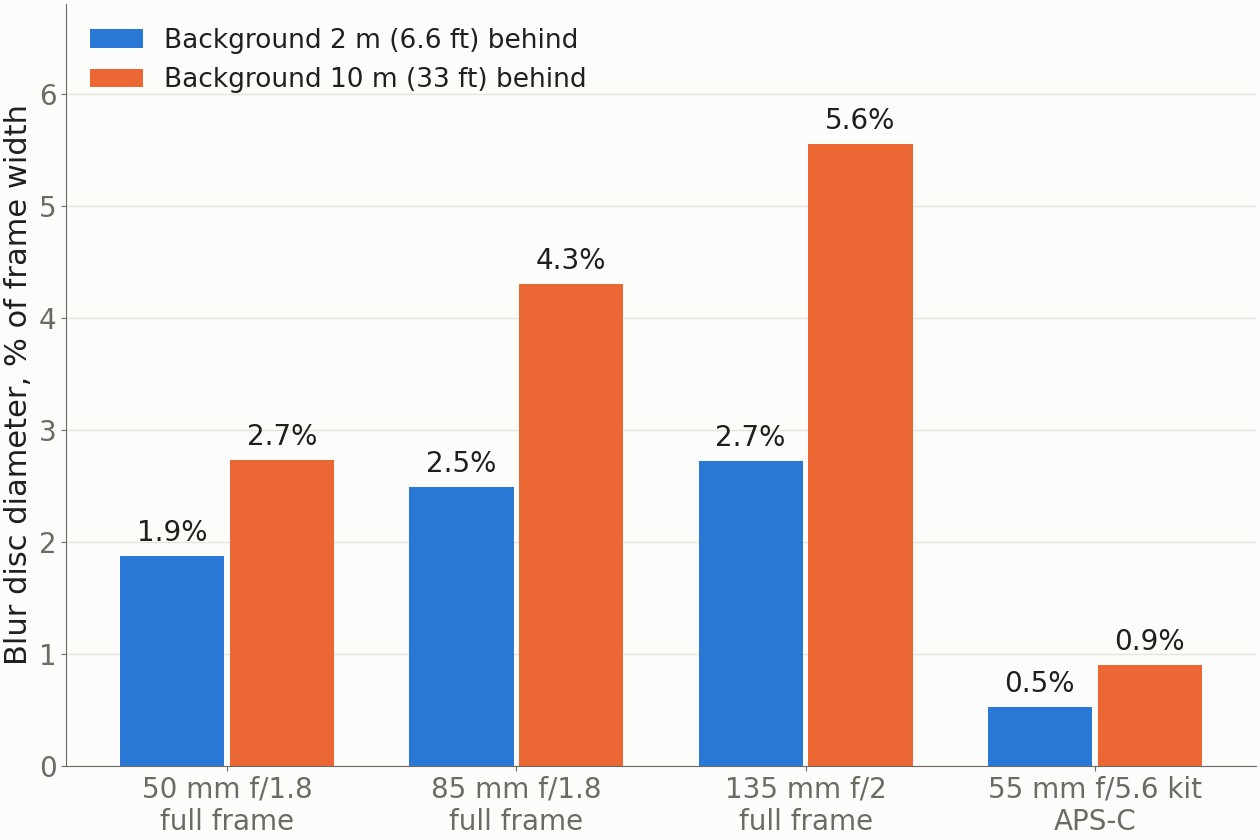
Lens marketing sells blur by the f-number. The f-number is half the story. The blur you see behind a portrait depends on how big the blur discs grow relative to the frame. That size follows from four distances and one diameter. The table below computes it for four common portrait setups. One of them is the kit zoom that came with the camera, and it loses by a wide margin.
What is a shallow depth of field
A shallow depth of field is a thin zone of acceptable sharpness around the focus point. Outside that zone, every point of light spreads into a disc. Small discs still read as sharp. Large discs read as blur. The depth of field guide covers the definition and the limit that separates the two.
Two things are easy to mix up here. Depth of field is the thickness of the sharp zone. Background blur is how large the discs become far outside it. They move together when you change the aperture. They split apart when you change the focal length at the same framing. The table shows the split.
Background blur for four portrait setups, computed
Every setup frames the subject the same way: 0.9 m (3 ft) across the frame, a head-and-shoulders portrait in landscape orientation. Longer lenses stand further back to keep that framing. The full-frame setups use a 36 mm wide sensor. The kit zoom sits on APS-C, 23.5 mm wide.
| Setup | Subject distance | Aperture diameter | Depth of field | Blur, background 2 m behind | Blur, background 10 m behind |
|---|---|---|---|---|---|
| 50 mm f/1.8, full frame | 1.30 m | 27.8 mm | 6.8 cm | 0.673 mm = 1.87% of width | 0.983 mm = 2.73% |
| 85 mm f/1.8, full frame | 2.21 m | 47.2 mm | 6.8 cm | 0.897 mm = 2.49% | 1.547 mm = 4.30% |
| 135 mm f/2, full frame | 3.51 m | 67.5 mm | 7.5 cm | 0.980 mm = 2.72% | 1.999 mm = 5.55% |
| 55 mm f/5.6 kit zoom, APS-C | 2.16 m | 9.8 mm | 31.9 cm | 0.123 mm = 0.52% | 0.211 mm = 0.90% |
Read the depth of field column first. The only column that barely moves is that one. The three primes keep almost the same sharp zone: 6.8, 6.8 and 7.5 cm. Now read the blur columns. With the background 10 m back, the 135 mm makes discs twice as wide as the 50 mm. Same sharp zone, very different picture.
The kit zoom keeps 31.9 cm sharp and blurs the background a fifth as much as the 85 mm. Its blur disc is 7 times the APS-C circle of confusion at 2 m and 11 times at 10 m. The 85 mm disc is 31 times the full-frame limit at 2 m and 54 times at 10 m.
Verdict: Background blur at a fixed framing tracks the aperture diameter, not the f-number alone. The 85 mm f/1.8 opens 47.2 mm. The kit zoom at 55 mm and f/5.6 opens 9.8 mm. That ratio, almost 5 to 1, is most of the difference in the chart.
The formula behind the table
The blur disc on the sensor for a background point follows from thin-lens geometry. Focus sits at distance s, the background at distance D, both measured from the lens:
b = f² × (D − s) ÷ (N × (s − f) × D)
Here f is the focal length and N the f-number. The share of the frame is b divided by the sensor width. Wikipedia's depth of field article gives the same relation in another form: b = d × m × x ÷ D. There d is the aperture diameter, m the magnification and x the subject-to-background distance.
That second form explains the verdict. At a fixed framing, m × sensor width is fixed. So the blur share depends on d and on x ÷ D. As the background moves to infinity, x ÷ D approaches 1. The blur share then approaches d divided by the framed width. For the 135 mm at f/2, that ceiling is 67.5 mm ÷ 900 mm, or 7.5% of the frame.
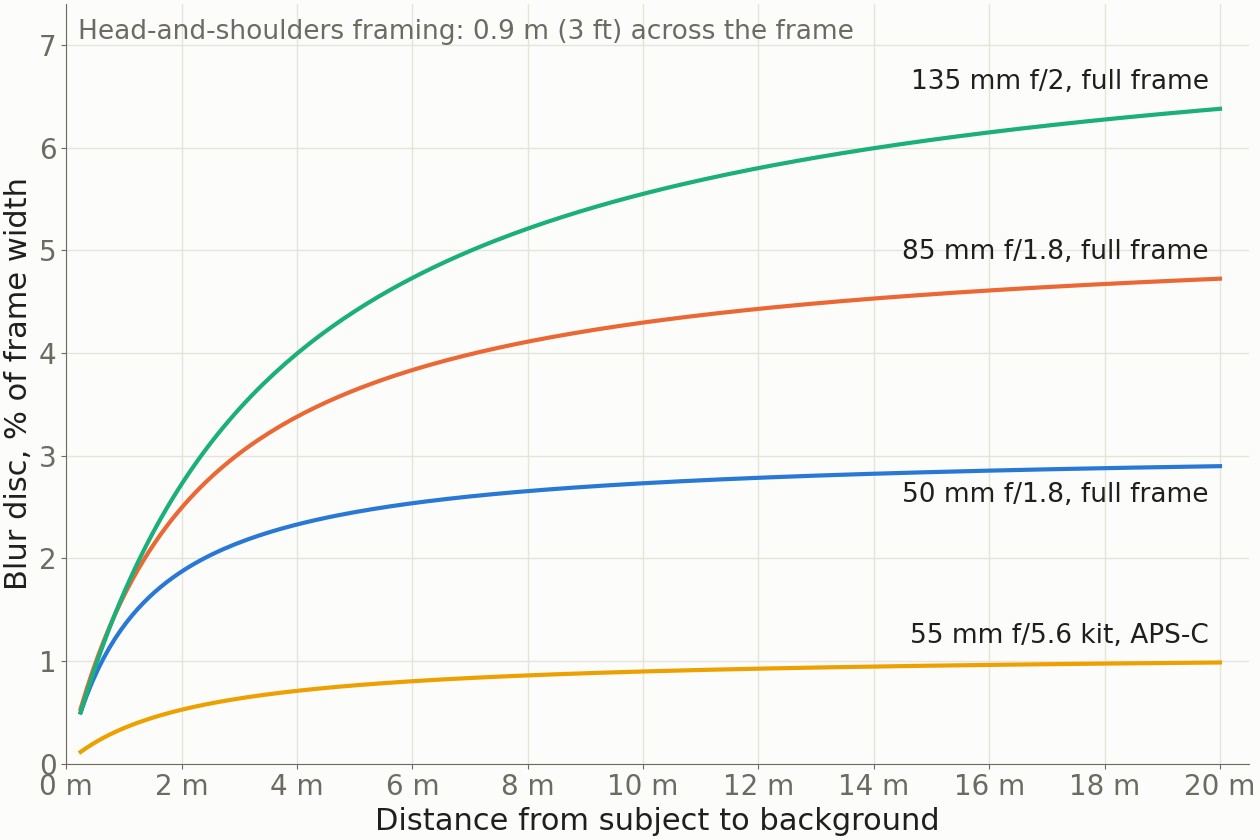
The curves also show where background distance stops paying. With 2 m of separation, the 50 mm already reaches 61% of its ceiling. The 135 mm reaches 36%. Past 10 m, the 50 mm curve is nearly flat. The 135 mm keeps climbing, because its ceiling sits higher.
Five levers, ranked by stops of blur
One stop of blur here means the blur disc doubles in diameter. The base case is a 50 mm lens at f/4 on full frame, head-and-shoulders framing, background 2 m behind. That makes discs 0.84% of the frame width. Each row changes one thing.
| Rank | Lever | The move | Blur multiplier | Stops of blur |
|---|---|---|---|---|
| 1 | Frame tighter | 0.9 m across to 0.45 m across (face only) | 2.47 | 1.30 |
| 2 | Open the aperture | f/4 to f/1.8 | 2.22 | 1.15 |
| 3 | Bigger sensor, same f-number and framing | Micro Four Thirds to full frame | 2.01 | 1.01 |
| 4 | Longer lens, step back to keep framing | 50 mm to 135 mm | 1.62 | 0.69 |
| 5 | Move the background away | 2 m behind to 10 m behind | 1.46 | 0.55 |
The ranking depends on the size of each move, so read it as a ranking of realistic moves. Two notes change the picture. A kit zoom at f/5.6 against an f/1.8 prime is a 1.64 stop gap on its own. And the longer lens gains more when the background is far. With the background 10 m back, 135 mm against 50 mm is worth 1.18 stops instead of 0.69.
APS-C to full frame, at the same f-number and framing, is worth 0.61 stops. Opening the same lens from f/2.8 to f/1.8 buys 0.64 stops. The depth of field guide tests the full-frame claim in detail.
How to get a shallow depth of field, step by step
- Open the aperture to its widest setting. Use aperture priority or manual mode. The aperture and f-stops guide explains the scale.
- Fill the frame. Head and shoulders blurs more than full length. A face alone blurs more still.
- Choose the longest lens the space allows, then step back until the framing matches. An 85 mm lens is the classic full-frame choice for this.
- Pull the subject away from the wall. The first 2 m of separation buy the most blur.
- Focus on the near eye. At 6.8 cm of depth, the far eye of a turned head can fall outside the zone.
Check that last step with numbers before a shoot. The depth of field calculator opens below on the 85 mm portrait from the table.
Depth of field calculator
- Near limit
- 2.18 m
- Far limit
- 2.24 m
- Total depth
- 0.07 m
- Hyperfocal
- 139.2 m
Circle of confusion 0.0288 mm (sensor diagonal / 1500). Thin-lens model, distance measured from the sensor. Focus at the hyperfocal distance and everything from half that distance to infinity is acceptably sharp.
Shallow depth of field on a budget
The cheapest lever in the table costs nothing: frame tighter and move the subject away from the background. The next lever is a fast prime. A prime lens has one fixed focal length. A 50 mm f/1.8 prime opens 27.8 mm. That is 2.8 times the kit zoom's 9.8 mm at 55 mm and f/5.6. On APS-C it frames like a 77 mm lens on full frame (50 × 1.53). On full frame, an 85 mm f/1.8 lens opens 47.2 mm, 4.8 times the kit zoom.
What is bokeh, and what it is not
Bokeh is the quality of the blur, not its amount. The word comes from the Japanese boke, meaning blur or haze, as Wikipedia's bokeh article records. Two lenses can make blur discs of the same size. One renders them as smooth even circles. The other renders them with bright rims or busy edges. The table on this page measures size only. Quality depends on the lens design and has no single number.
The "bokeh effect" mode on phones imitates the size part in software. Wikipedia's bokeh article describes how: the phone builds a depth map and blurs the parts it marks as background. The formula above describes what a real lens of a given opening would do.
How the numbers were computed
- Framing: magnification m = sensor width ÷ 900 mm. Subject distance from the lens s = f × (1 + 1 ÷ m), the thin-lens equation.
- Blur disc: b = f² × (D − s) ÷ (N × (s − f) × D), with D = s + 2 m or s + 10 m. Share of frame = b ÷ sensor width.
- Aperture diameter: d = f ÷ N, from the definition of the f-number.
- Depth of field: the calculator's formulas, with the subject distance from the table. Circle of confusion = sensor diagonal ÷ 1500: 0.0288 mm full frame, 0.0188 mm APS-C.
- Stops of blur: log base 2 of the blur multiplier.
Hand check, 85 mm f/1.8 row: m = 36 ÷ 900 = 0.04, so s = 85 × 26 = 2,210 mm. D = 4,210 mm. b = 7,225 × 2,000 ÷ (1.8 × 2,125 × 4,210) = 0.897 mm. That is 2.49% of 36 mm. The depth of field column treats the subject distance as the calculator does, from the sensor. The two references differ by about one focal length plus a few millimeters, under 5% here.
Frequently asked questions
- What is a shallow depth of field?
- A shallow depth of field is a thin zone of sharpness around the focus point, with everything in front and behind it blurred. Portrait photographers use it to separate a face from a busy background. An 85 mm lens at f/1.8 on full frame, framing head and shoulders from 2.21 m, keeps a zone 6.8 cm deep sharp.
- How do you get a shallow depth of field?
- Open the aperture, frame tighter, use a longer lens and step back to keep the framing, and put distance between the subject and the background. At the same framing, the aperture diameter in millimeters decides most of the blur. An 85 mm f/1.8 has a 47.2 mm opening; a 55 mm kit zoom at f/5.6 has 9.8 mm.
- What is bokeh?
- Bokeh is the look of the out-of-focus areas: how smooth, round or busy the blur appears. The word comes from the Japanese boke, meaning blur or haze. Bokeh is a quality, while blur size is a quantity. A lens can produce large blur discs with harsh edges, which reads as busy bokeh despite the strong blur.
- Does a longer lens give more background blur?
- At the same framing, yes, and the effect grows with background distance. With head-and-shoulders framing at f/2 and a background 10 m behind, a 135 mm lens makes blur discs 5.6% of the frame width. A 50 mm lens at f/1.8 makes 2.7%. The depth of field around the face stays almost the same: 7.5 cm against 6.8 cm.
- Is shallow depth of field the same as background blur?
- No. Depth of field is the zone that looks sharp; background blur is how large the blur discs grow outside it. At the same framing and f-number, depth of field barely changes with focal length. Background blur changes a lot. That is why 50, 85 and 135 mm portraits look different even when the sharp zone is equally thin.
Sources
- Depth of field (foreground and background blur), Wikipedia (2026)
- Bokeh, Wikipedia (2026)
- F-number, Wikipedia (2026)
- Circle of confusion, Wikipedia (2026)