What is focal length in photography?
by Piotr · Photography Tips
In short: Focal length is the distance from the lens's rear principal plane to the sensor, focused at infinity. On its own it says little. Pair it with a sensor size and it becomes an angle. On full frame, 14 mm sees 104.3° across, 50 mm sees 39.6° and 400 mm sees 5.2°. The tables below convert every common focal length into degrees and meters.
A focal length is printed on every lens, and almost nobody can picture it. "50 mm" describes a distance inside the lens. What you care about is outside the lens: how wide a slice of the world reaches the sensor. This page converts the first into the second, for three sensor sizes. The arithmetic is short, and the calculator does it for any lens.
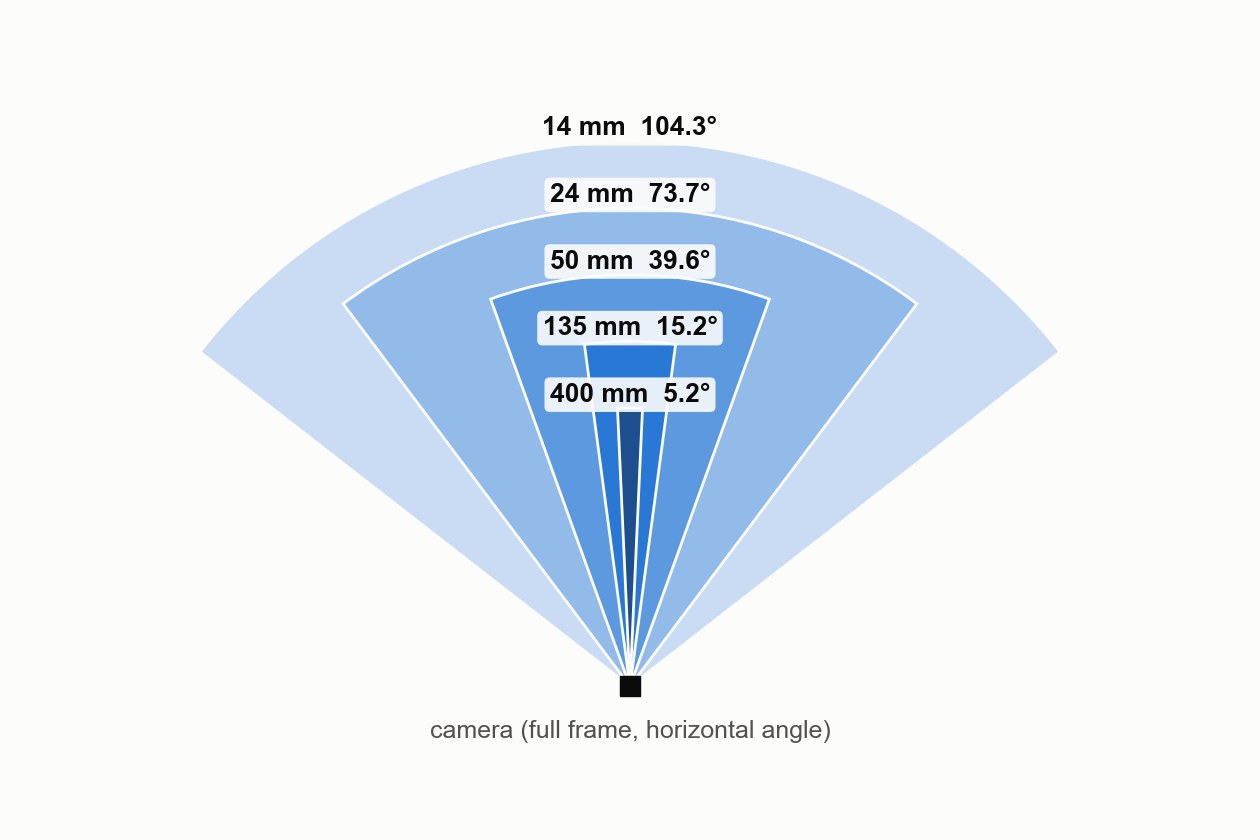
Focal length is a distance inside the lens
Focus a lens at infinity. The distance from its rear principal plane to the sensor is the focal length, per the focal length article. Focus closer and that distance grows a little. Focal length is a fixed property of the optical design. It has nothing to do with how long the barrel is.
That last point surprises people. A true telephoto lens is physically shorter than its focal length. The trick is a rear lens group that moves the principal plane forward, out in front of the glass. Our telephoto lens guide covers that design and the "compression" myth that rides along with it.
Angle of view by focal length on three sensor sizes
The angle is the main number to remember. The table gives the horizontal angle, the one that matches how wide a landscape-orientation frame looks. The last column adds the diagonal angle on full frame, because most spec sheets print that one.
| Focal length | Full frame, horizontal | APS-C, horizontal | Micro Four Thirds, horizontal | Full frame, diagonal |
|---|---|---|---|---|
| 14 mm | 104.3° | 80.0° | 63.4° | 114.2° |
| 16 mm | 96.7° | 72.6° | 56.8° | 107.0° |
| 20 mm | 84.0° | 60.9° | 46.8° | 94.5° |
| 24 mm | 73.7° | 52.2° | 39.6° | 84.1° |
| 28 mm | 65.5° | 45.5° | 34.3° | 75.4° |
| 35 mm | 54.4° | 37.1° | 27.8° | 63.4° |
| 50 mm | 39.6° | 26.4° | 19.6° | 46.8° |
| 85 mm | 23.9° | 15.7° | 11.6° | 28.6° |
| 105 mm | 19.5° | 12.8° | 9.4° | 23.3° |
| 135 mm | 15.2° | 9.9° | 7.3° | 18.2° |
| 200 mm | 10.3° | 6.7° | 5.0° | 12.3° |
| 300 mm | 6.9° | 4.5° | 3.3° | 8.2° |
| 400 mm | 5.2° | 3.4° | 2.5° | 6.2° |
| 600 mm | 3.4° | 2.2° | 1.7° | 4.1° |
How the numbers were computed. Angle = 2 × arctan(sensor dimension ÷ (2 × focal length)), the rectilinear formula from the angle of view article. Sensor widths: full frame 36 mm, APS-C 23.5 mm, Micro Four Thirds 17.3 mm. The full-frame diagonal is 43.27 mm.
Two patterns hide in the table. At the long end, double the focal length and the angle halves: 200 mm sees 10.3°, 400 mm sees 5.2°. At the wide end, that rule breaks. Going from 28 mm to 14 mm adds only 38.8°, not another 65.5°. The arctangent flattens out near 180°, which is why no rectilinear lens ever reaches it.
Frame width at 10 m for each lens
Degrees are abstract. Meters are not. The next table answers a practical question: stand 10 m (33 ft) from a wall, and how much of the wall fits in the frame?
| Focal length | Full frame | APS-C | Micro Four Thirds |
|---|---|---|---|
| 14 mm | 25.71 m (84.4 ft) | 16.79 m (55.1 ft) | 12.36 m (40.5 ft) |
| 16 mm | 22.50 m (73.8 ft) | 14.69 m (48.2 ft) | 10.81 m (35.5 ft) |
| 20 mm | 18.00 m (59.1 ft) | 11.75 m (38.5 ft) | 8.65 m (28.4 ft) |
| 24 mm | 15.00 m (49.2 ft) | 9.79 m (32.1 ft) | 7.21 m (23.6 ft) |
| 28 mm | 12.86 m (42.2 ft) | 8.39 m (27.5 ft) | 6.18 m (20.3 ft) |
| 35 mm | 10.29 m (33.7 ft) | 6.71 m (22.0 ft) | 4.94 m (16.2 ft) |
| 50 mm | 7.20 m (23.6 ft) | 4.70 m (15.4 ft) | 3.46 m (11.4 ft) |
| 85 mm | 4.24 m (13.9 ft) | 2.76 m (9.1 ft) | 2.04 m (6.7 ft) |
| 105 mm | 3.43 m (11.2 ft) | 2.24 m (7.3 ft) | 1.65 m (5.4 ft) |
| 135 mm | 2.67 m (8.7 ft) | 1.74 m (5.7 ft) | 1.28 m (4.2 ft) |
| 200 mm | 1.80 m (5.9 ft) | 1.18 m (3.9 ft) | 0.86 m (2.8 ft) |
| 300 mm | 1.20 m (3.9 ft) | 0.78 m (2.6 ft) | 0.58 m (1.9 ft) |
| 400 mm | 0.90 m (3.0 ft) | 0.59 m (1.9 ft) | 0.43 m (1.4 ft) |
| 600 mm | 0.60 m (2.0 ft) | 0.39 m (1.3 ft) | 0.29 m (0.9 ft) |
How the numbers were computed. Frame width = distance × sensor width ÷ focal length. This is the same triangle as the angle formula, read in meters. It assumes focus far away; close up, the real frame is a little smaller.
The table is linear, which makes it easy to scale. At 5 m, halve every number. At 20 m, double it. A 50 mm lens on full frame covers 7.20 m at 10 m, so it covers 0.72 m at 1 m. That one fact lets you frame most scenes in your head.
The calculator below runs the same formulas for any lens, sensor and distance. It starts at the 50 mm row of both tables.
Field of view calculator
- Horizontal angle
- 39.6°
- Vertical angle
- 27.0°
- Diagonal angle
- 46.8°
- Frame width at 10 m
- 7.20 m (23.6 ft)
- Frame height at 10 m
- 4.80 m (15.7 ft)
- Full-frame equivalent
- 50 mm (crop 1.00)
Angle = 2 x atan(sensor size / (2 x focal length)), for a rectilinear lens focused far away. Frame size = distance x sensor size / focal length. Fisheye lenses do not follow this formula.
Crop factor changes the angle, not the focal length
A 50 mm lens stays 50 mm on every body. A smaller sensor simply records a smaller piece of the same image. That is the whole story behind "crop factor".
The factor is the full-frame diagonal divided by the smaller sensor's diagonal. For APS-C at 23.5 x 15.6 mm, it computes to 1.53. For Micro Four Thirds at 17.3 x 13 mm, it computes to 2.00. Multiply a focal length by the factor and you get the full-frame lens that frames the same way. A 50 mm lens on APS-C frames like 77 mm. On Micro Four Thirds it frames like 100 mm.
The same arithmetic runs backward. To get the full-frame 50 mm view on APS-C, divide: 50 ÷ 1.53 = 32.6 mm. On Micro Four Thirds, 50 ÷ 2.00 = 25.0 mm. The APS-C vs full frame guide covers what else changes with the format. The sensor size guide lists the dimensions behind these factors.
The human eye is not a 50 mm lens
The claim is everywhere. Nikon's own focal length guide describes its standard range, home of the 50 mm, as "Closest to how the human eye sees". The eye has measurable numbers, so the claim can be tested. Here are the eye figures from published sources, each converted into the full-frame focal length that matches it.
| Eye figure | Value | Source | Full-frame lens that matches |
|---|---|---|---|
| Field both eyes share | about 120° horizontal | Human eye | 10.4 mm |
| Whole field, both eyes | about 214° horizontal | Human eye | None: rectilinear lenses stop short of 180° |
| Sharp central vision (fovea) | central 2° | Fovea centralis | 1,031 mm |
| Print viewed at its own diagonal | about 53° diagonal | Normal lens | 43.4 mm |
| A 50 mm lens, for comparison | 39.6° horizontal, 46.8° diagonal | Computed | 50 mm |
How the numbers were computed. Focal length = half the sensor dimension ÷ tan(half the angle). Horizontal rows use the 36 mm width; the print row uses the 43.27 mm diagonal.
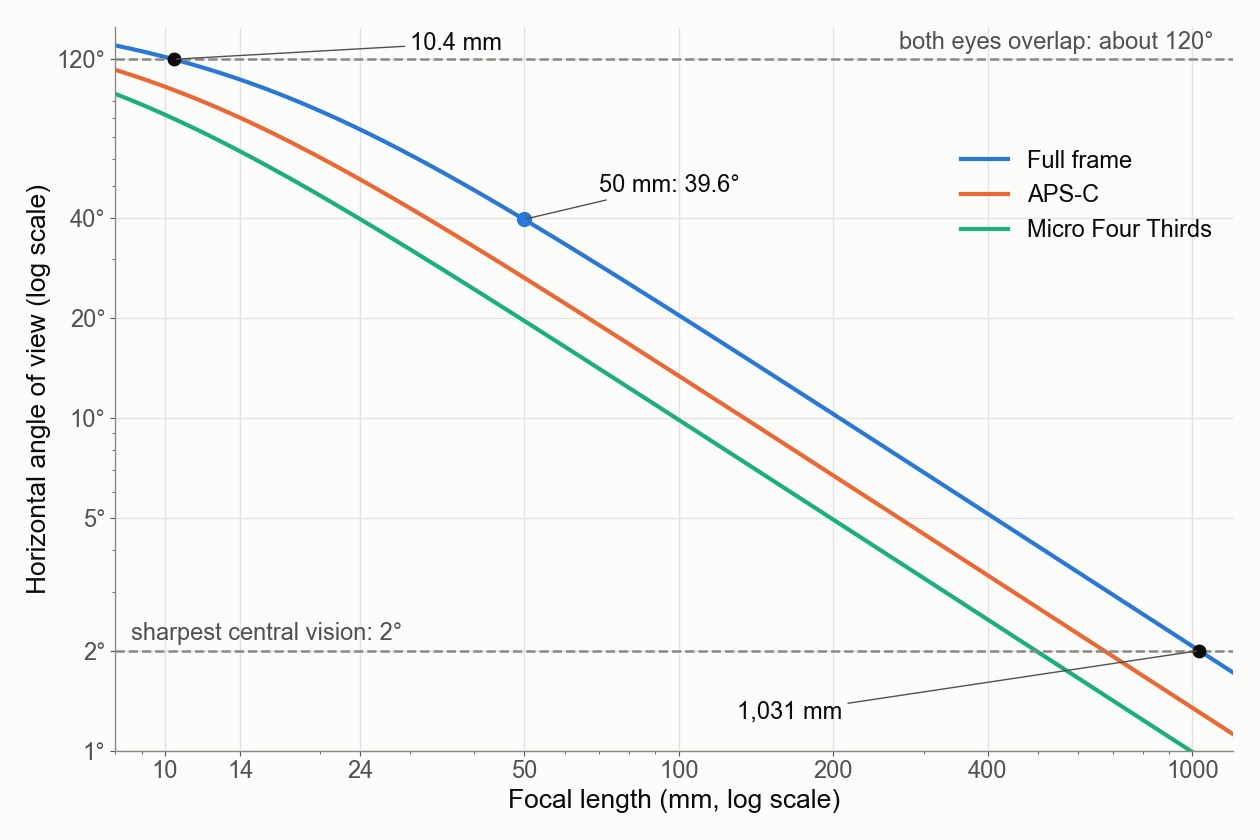
The answer is half yes, half no. As a field of view, the claim is false. The eye's shared field matches a 10.4 mm ultra-wide, and its sharp spot matches a 1,031 mm super-telephoto. No single lens sits anywhere near both. A 50 mm lens matches neither.
The eye even has its own focal length. The normal lens article gives about 17 mm. That number does not transfer either. The retina is curved, and a 17 mm lens on a flat full-frame sensor sees 93.3° across.
The other half of the claim survives. The normal-lens convention is about prints, not eyeballs. Take a lens about as long as the sensor diagonal. Its pictures look natural in perspective when the print is viewed from a distance equal to its diagonal. On full frame that lens is 43 mm. The same article lists 40 to 58 mm as normal and 50 mm as the most common choice. So the honest version reads: 50 mm is close to normal perspective, not to human vision.
Focal length sets framing, and distance sets perspective
Swap a 24 mm lens for a 135 mm lens without moving. Every object keeps its size relative to every other object. The longer lens just crops the middle of the scene. Perspective changes only when you walk. Longer lenses push you to walk backward to keep the same framing, and that walk changes the proportions.
This is where "lens compression" comes from, and it is a distance effect. The telephoto lens guide proves it with a computed table. The types of camera lenses overview shows how the classes, from ultra-wide to super-telephoto, follow from focal length.
Pick a focal length from the scene
Turn the coverage formula around and it picks the lens for you. Focal length = sensor width × distance ÷ subject width. Say the subject is 2 m wide and you can stand 5 m away on full frame. That gives 36 × 5 ÷ 2 = 90 mm. On APS-C the same scene needs 23.5 × 5 ÷ 2 = 58.8 mm.
Run that once before buying a lens. It answers the question a focal-length chart cannot: will this lens fit my room, my stage, my backyard? The routine takes four steps:
- Measure the subject. Pace out its width and add 0.5 m (1.6 ft) of margin on each side.
- Measure the distance. Note how far back you can actually stand.
- Compute the focal length. Multiply the sensor width by the distance, then divide by the subject width.
- Round down. Pick the nearest focal length shorter than the result, so the subject fits with room to spare. The field of view calculator has worked examples for groups and tight rooms.
The rule worth keeping: a 50 mm lens on full frame covers 0.72 m of width for every meter of distance. On APS-C the same lens covers 0.47 m per meter (23.5 ÷ 50). For any other lens, divide the sensor width by the focal length.
Frequently asked questions
- What is focal length in photography?
- Focal length is the distance from the lens's rear principal plane to the sensor when the lens is focused at infinity, given in millimeters. With the sensor size, it fixes the angle of view. On full frame, 14 mm sees 104.3 degrees horizontally, 50 mm sees 39.6 degrees, and 400 mm sees 5.2 degrees. Longer focal length means a narrower view and a bigger subject.
- What focal length is the human eye?
- No single focal length matches the eye. Both eyes overlap across about 120 degrees, which a 10.4 mm lens matches horizontally on full frame. Sharp central vision covers 2 degrees, which takes 1,031 mm. The 50 mm claim comes from the normal-lens convention. A lens as long as the sensor diagonal, 43 mm on full frame, gives natural perspective in a print viewed at its diagonal.
- Does focal length change on a crop sensor?
- No. A 50 mm lens is 50 mm on every camera. The smaller sensor records a smaller part of the image, so the angle of view shrinks. On APS-C (23.5 x 15.6 mm) the crop factor is 1.53, so 50 mm frames like 77 mm on full frame. On Micro Four Thirds the factor is 2.00, so 50 mm frames like 100 mm.
- What is the difference between field of view and focal length?
- Focal length is a property of the lens, in millimeters. Field of view is the angle the camera records, in degrees, and it depends on both the focal length and the sensor size. The formula is angle = 2 x arctan(sensor size / (2 x focal length)). Double the focal length and the angle roughly halves, as long as the angle is small.
- Which focal length is normal on full frame?
- A normal lens has a focal length close to the sensor diagonal. The full-frame diagonal is 43.27 mm, and Wikipedia's normal-lens article lists 40 to 58 mm as normal, with 50 mm the most common. A 43 mm lens covers 53 degrees diagonally. A 50 mm lens covers 46.8 degrees diagonally and 39.6 degrees horizontally.
Sources
- Focal length, Wikipedia contributors (2026)
- Normal lens, Wikipedia contributors (2026)
- Human eye (visual field), Wikipedia contributors (2026)
- Fovea centralis, Wikipedia contributors (2026)
- Angle of view (photography), Wikipedia contributors (2026)
- What is focal length? A guide for beginners, Nikon (2026)