Telephoto lens, defined and measured
by Piotr · Photography Tips
As an Amazon Associate I earn from qualifying purchases. Links to Amazon on this page are affiliate links.
In short: A telephoto lens is a long lens with a narrow view; in strict optics it is also physically shorter than its focal length. The famous "compression" is real in the photo but does not come from the lens. It comes from standing farther away. The tables below compute both claims, plus reach for wildlife and safe handheld speeds.
Telephoto lenses come wrapped in folklore. They "compress" backgrounds. They "flatten" faces. They make mountains "loom". The photos are real. The glass is not the cause. This page separates the two with geometry you can check on a napkin.
Telephoto lens: the definition
The word has two meanings, and both are in use. Photographers call any lens longer than normal a telephoto. Optical designers mean something narrower. Per the telephoto lens article, a telephoto is a long-focus lens "in which the physical length of the lens is shorter than the focal length".
The trick is a rear group of lens elements that spreads the light back out. That moves the lens's optical center out in front of the barrel. The ratio of physical length to focal length is the telephoto ratio. A plain long-focus lens sits near 1. The same article cites a Canon EF 400 mm f/4 DO IS at 0.58.
The same article sorts telephotos by focal length on full frame:
| Class | Focal length (full frame) | Horizontal angle of view |
|---|---|---|
| Short or portrait telephoto | 85 to 135 mm | 23.9° to 15.2° |
| Medium telephoto | 135 to 300 mm | 15.2° to 6.9° |
| Super telephoto | over 300 mm | under 6.9° |
How the numbers were computed. Ranges are from the telephoto lens article. Angles: 2 × arctan(36 ÷ (2 × focal length)). Our types of camera lenses overview starts the class at 70 mm. The borders are conventions, not optics.
For anything longer than full frame's normal lens, the focal length guide converts each focal length into degrees and meters on three sensor sizes.
Lens compression is a distance effect
Here is the myth in its usual form: a telephoto lens compresses space, so the background looks bigger and closer. The photos do show that. The actual cause is the photographer's feet.
The test scene is simple. A person 1.8 m tall stands in front of a row of trees 10 m tall. The trees stand 50 m behind the person. A full-frame camera frames 2.0 m of height at the person, at every focal length. A longer lens means standing farther back to keep that framing.
| Focal length | Camera distance | Person in frame | Tree in frame | Tree ÷ person | Width of tree line in frame |
|---|---|---|---|---|---|
| 24 mm | 2.0 m (6.6 ft) | 21.6 mm | 4.62 mm | 0.21 | 78.0 m (256 ft) |
| 50 mm | 4.17 m (13.7 ft) | 21.6 mm | 9.23 mm | 0.43 | 39.0 m (128 ft) |
| 135 mm | 11.25 m (36.9 ft) | 21.6 mm | 22.04 mm | 1.02 | 16.3 m (54 ft) |
| 400 mm | 33.3 m (109.4 ft) | 21.6 mm | 48.00 mm | 2.22 | 7.5 m (25 ft) |
How the numbers were computed. Camera distance = 2.0 m × focal length ÷ 24 mm (frame height). Image size on the sensor = focal length × object size ÷ object distance. Tree line width = (camera distance + 50 m) × 36 ÷ focal length. The sensor is 24 mm tall, so the 400 mm tree is twice the frame height.
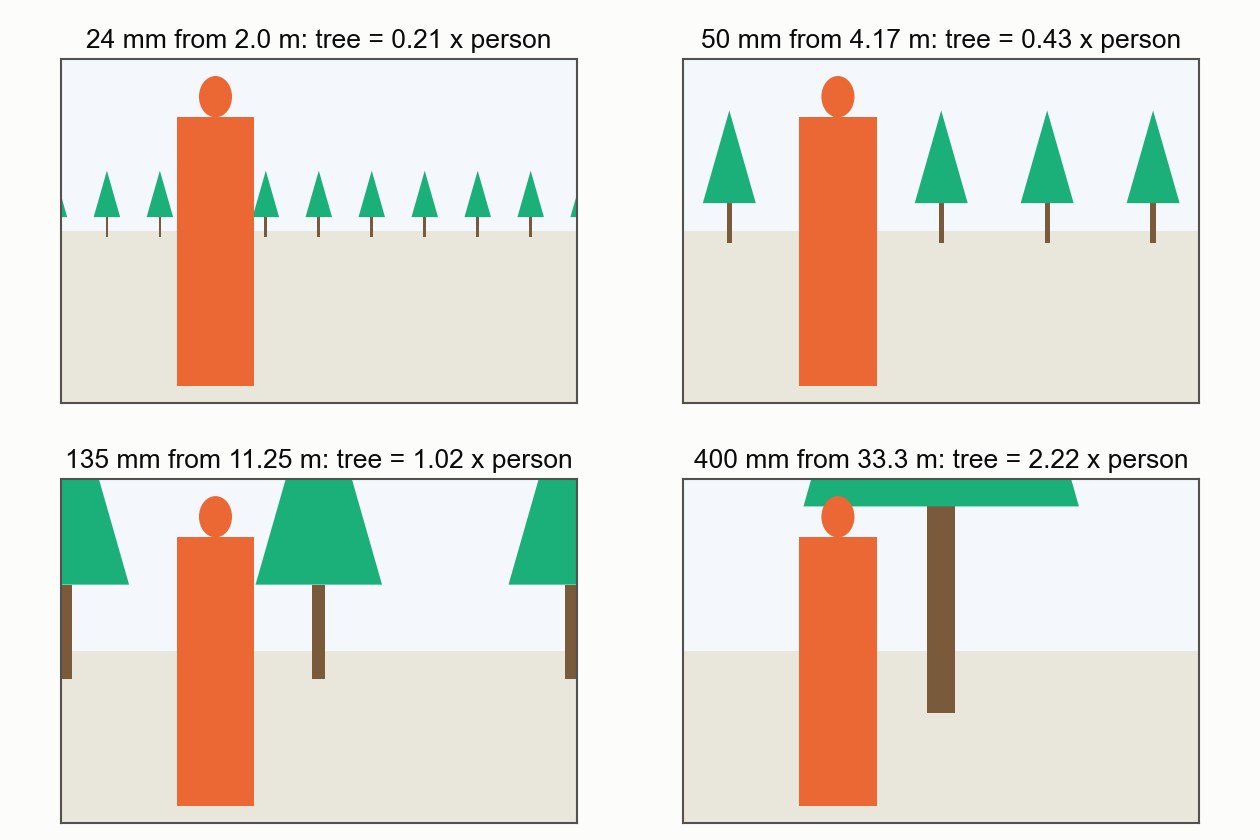
The person never changes size. The tree grows tenfold, from 0.21 to 2.22 times the person. That is the "compression" in the photos. Now hold the camera still and change only the lens.
| Focal length, camera at 11.25 m | Person in frame | Tree in frame | Tree ÷ person |
|---|---|---|---|
| 24 mm | 3.8 mm | 3.92 mm | 1.02 |
| 50 mm | 8.0 mm | 8.16 mm | 1.02 |
| 135 mm | 21.6 mm | 22.04 mm | 1.02 |
| 400 mm | 64.0 mm | 65.31 mm | 1.02 |
The ratio does not move. Every lens magnifies the person and the tree by the same factor, because both sizes scale with the focal length. The algebra shows it in one line. Tree ÷ person = (10 m ÷ 1.8 m) × camera distance ÷ (camera distance + 50 m). Focal length cancels out. Only the distances remain.
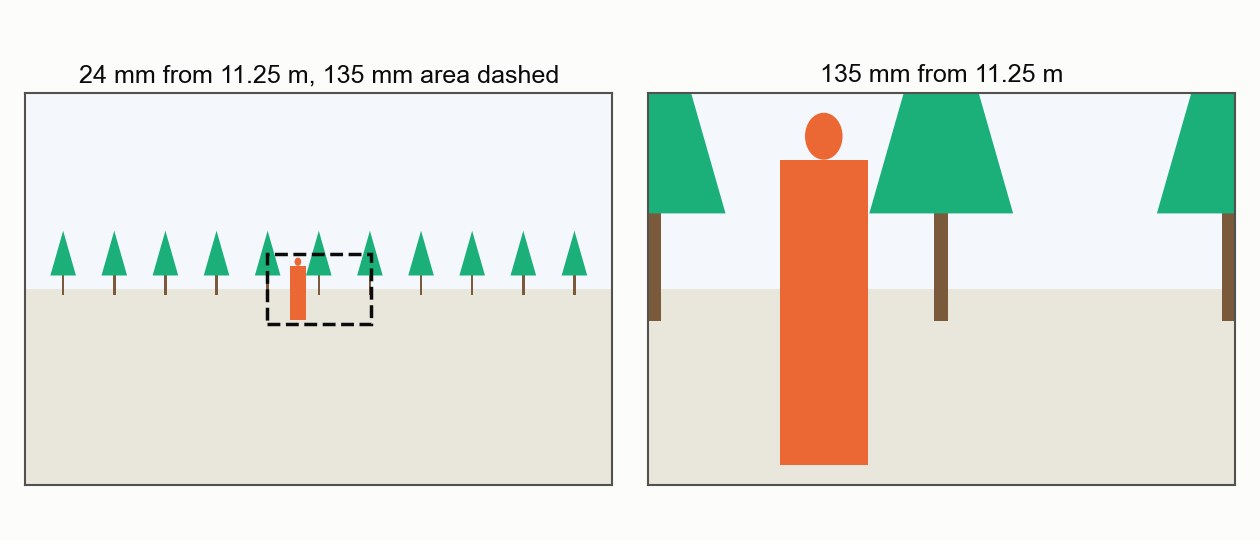
The perspective distortion article states the same verdict in words. Linear perspective changes "are caused by distance, not by the lens per se". So the myth is half true. The look is real, and you need a telephoto to get it at a usable size. But the lens is the enabler. The distance is the cause.
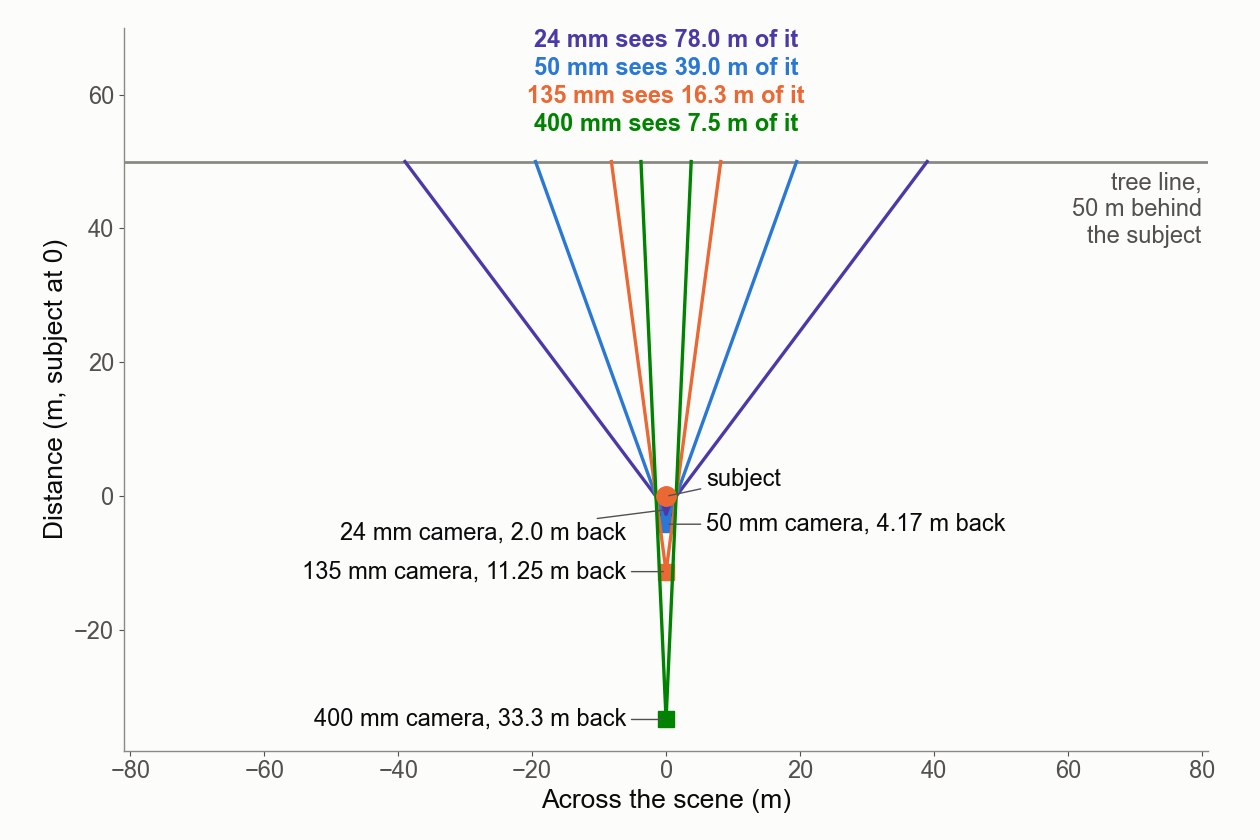
The top view shows the second half of the effect. At 24 mm the frame takes in 78.0 m of the tree line. At 400 mm it takes in 7.5 m. Fewer, larger trees fill the same frame. That is why a long lens gives such a clean, simple background behind a portrait.
Why the crop is not a substitute
If compression comes from distance, why carry a long lens at all? Stand at 11.25 m with a 24 mm lens and crop to the 135 mm framing. The crop is 135 ÷ 24 = 5.62 times narrower on each side. A 24-megapixel file keeps 24 ÷ 5.62² = 0.76 megapixels. A 45-megapixel file keeps 1.42 megapixels.
So the answer is pixels, not perspective. The telephoto earns its weight there. It puts the whole sensor on the slice of the scene you chose by where you stood.
Telephoto lenses for wildlife: reach in pixels
Wildlife is where focal length turns into a pixel count. The table assumes a bird 15 cm (6 in) long, side-on. Both sensors are 6,000 pixels wide, which is 24 megapixels in a 3:2 frame.
| Focal length | Full frame, 10 m | APS-C, 10 m | Full frame, 20 m | APS-C, 20 m |
|---|---|---|---|---|
| 200 mm | 500 px (8.3%) | 766 px (12.8%) | 250 px (4.2%) | 383 px (6.4%) |
| 300 mm | 750 px (12.5%) | 1,149 px (19.1%) | 375 px (6.2%) | 574 px (9.6%) |
| 400 mm | 1,000 px (16.7%) | 1,532 px (25.5%) | 500 px (8.3%) | 766 px (12.8%) |
| 600 mm | 1,500 px (25.0%) | 2,298 px (38.3%) | 750 px (12.5%) | 1,149 px (19.1%) |
How the numbers were computed. Frame width at distance = distance × sensor width ÷ focal length (36 mm full frame, 23.5 mm APS-C). Share of frame = 0.15 m ÷ frame width. Pixels = share × 6,000.
Two readings matter. First, distance hurts as much as focal length helps. Doubling the distance halves the pixels, so 600 mm at 20 m equals 300 mm at 10 m. Getting closer beats buying longer.
Second, the "crop sensor adds reach" claim is half true. With the same 6,000-pixel width, APS-C puts 1.53 times more pixels on the bird. That is the crop factor, and it is real. With fewer pixels on the smaller sensor, the gain shrinks or disappears. The APS-C vs full frame guide explains the format trade-offs.
For buying, the criterion is the table: reach at the distance your subjects allow. A 70 to 300 mm telephoto zoom covers the 300 mm row. For small birds, a 150 to 600 mm telephoto zoom reaches the 600 mm row. A 1.4x teleconverter multiplies focal length by 1.4, if your lens accepts one.
Handheld shutter speed by focal length
Long lenses magnify shake as much as they magnify birds. The shutter speed guide gives the rule of thumb: the slowest safe handheld speed is 1 ÷ (2 × focal length). Use the 35 mm equivalent focal length, so multiply by the crop factor first.
| Focal length | Full frame | APS-C (× 1.53) | Micro Four Thirds (× 2.00) |
|---|---|---|---|
| 70 mm | 1/140 s | 1/215 s | 1/280 s |
| 100 mm | 1/200 s | 1/307 s | 1/400 s |
| 135 mm | 1/270 s | 1/414 s | 1/540 s |
| 200 mm | 1/400 s | 1/614 s | 1/800 s |
| 300 mm | 1/600 s | 1/920 s | 1/1200 s |
| 400 mm | 1/800 s | 1/1227 s | 1/1600 s |
| 600 mm | 1/1200 s | 1/1841 s | 1/2399 s |
How the numbers were computed. 1 ÷ (2 × focal length × crop factor), rounded to whole numbers. Crop factors are the full-frame diagonal over each sensor's diagonal. Use the next faster speed your camera offers.
The image stabilization article calls the film-era version, 1 ÷ focal length, the "1/mm rule". It suggests twice that speed for high-resolution sensors, which is the table above. Stabilization stretches these limits for still subjects. It does nothing for a bird that moves.
Zoom vs telephoto lens
These two words answer different questions. Zoom says the focal length changes. Telephoto says the focal length is long. A 70 to 300 mm zoom is both at once. An 85 mm lens is a short telephoto with no zoom at all. A kit zoom that stops at 55 mm is a zoom that never reaches telephoto on full frame.
So the real choice is between a telephoto zoom and a telephoto prime. The zoom reframes without walking. The prime gives up that flexibility, so compare maximum apertures at the focal length you need. Neither one compresses anything; your position does that.
Telephoto vs wide-angle lens: the same rule, reversed
A wide-angle lens used close up stretches depth. A telephoto used far away squeezes it. Swap them at the same spot and both effects vanish, as the 11.25 m table shows. The types of camera lenses overview compares the two classes side by side.
The verdict: a telephoto lens buys pixels on a distant subject. The compressed look comes from where you stand. The only order that works:
- Pick the spot. Choose the distance that gives the background size you want.
- Pick the focal length. Use the one that fills the frame from that spot.
- Pick the shutter speed. Read it off the handheld table above.
Frequently asked questions
- What is a telephoto lens?
- Photographers use the word for any lens longer than normal, with a narrow angle of view that makes distant subjects large. In optics it means a specific design: a lens whose physical length is shorter than its focal length, thanks to a rear lens group. Wikipedia splits the class into short (85 to 135 mm), medium (135 to 300 mm) and super (over 300 mm) on full frame.
- Does a telephoto lens compress the background?
- Not by itself. Shot from the same spot, a 24 mm and a 400 mm lens give identical proportions. The 400 mm frame is a crop of the 24 mm frame. Compression appears because a longer lens makes you stand farther back to keep the same framing. In the computed example, moving from 2 m to 33.3 m makes a background tree grow from 0.21 to 2.22 times the subject.
- What focal length do you need for wildlife?
- It depends on subject size and distance, and the arithmetic is simple. Take a bird 15 cm long at 10 m. At 400 mm on full frame it fills 16.7% of the frame width, 1,000 pixels on a sensor 6,000 pixels wide. At 600 mm it fills 25.0%. An APS-C sensor with the same pixel count puts 1.53 times more pixels on the bird.
- What is the difference between zoom and telephoto?
- They answer different questions. Zoom means the focal length can change; telephoto means the focal length is long. A 70 to 300 mm zoom is both. An 85 mm prime is a telephoto without zoom. A kit zoom that stops at 55 mm never reaches telephoto on full frame.
- What shutter speed should you use with a telephoto lens?
- A common starting point is 1 divided by twice the 35 mm equivalent focal length. That gives 1/800 s at 400 mm on full frame, 1/1227 s on APS-C and 1/1600 s on Micro Four Thirds. Use the next faster speed your camera offers. Stabilization lengthens these limits for still subjects only.
Sources
- Telephoto lens, Wikipedia contributors (2026)
- Perspective distortion, Wikipedia contributors (2026)
- Image stabilization (the 1/mm rule), Wikipedia contributors (2026)
- Angle of view (photography), Wikipedia contributors (2026)