Star trails photography by the numbers
by Piotr · Photography Tips
As an Amazon Associate I earn from qualifying purchases. Links to Amazon on this page are affiliate links.
In short: The Earth turns once per 23.9345 hours against the stars, so every star circles the celestial pole at 15.04 degrees per hour. At 20 mm on a 24 MP full-frame camera, one hour draws about 900 pixels of trail. Shoot it as 30-second frames, 117 per hour, and stack them with a lighten blend.
Star trails look like an art form. Underneath, they are a clock. The stars move at one fixed rate, so the length of every trail follows from time, focal length and pixel size. The single number behind every table here is 15.04 degrees per hour. This page turns it into tables you can plan a night with.
What star trails are
A star trail is the path a star draws across a long exposure or a stack of frames. The stars do not move. Your camera does, riding the Earth's rotation. Wikipedia's article calls these paths diurnal circles, all centered on the celestial pole.
The rate comes from NASA's Earth fact sheet: a sidereal rotation period of 23.9345 hours. That is one full turn against the stars. Divide 360 degrees by it and you get 15.04 degrees per hour, or 0.25 degrees per minute.
Where you point decides the shape. Aim north in the Northern Hemisphere and the arcs circle a point very near Polaris. Aim east or west and the stars on the celestial equator draw straight streaks.
Trail length in degrees, by declination
Every star turns through the same 15.04 degrees per hour around the pole. The length of its path on the sky still differs. A star's declination is its distance from the celestial equator. Its path length shrinks with the cosine of that angle.
| Declination | 30 min | 1 h | 2 h | 4 h |
|---|---|---|---|---|
| 0° (celestial equator) | 7.5° | 15.0° | 30.1° | 60.2° |
| 30° | 6.5° | 13.0° | 26.1° | 52.1° |
| 45° | 5.3° | 10.6° | 21.3° | 42.5° |
| 60° | 3.8° | 7.5° | 15.0° | 30.1° |
| 75° | 1.9° | 3.9° | 7.8° | 15.6° |
| 85° | 0.7° | 1.3° | 2.6° | 5.2° |
Path length on the sky = 15.04° × hours × cos(declination). The angle swept around the pole is 15.04° per hour for every star.
The table explains a common disappointment. Stars near the pole draw tight, short arcs. An hour at declination 85 degrees gives 1.3 degrees of path. The long, sweeping lines belong to stars far from the pole.
The rate also caps what one night can do. A quarter circle around the pole takes 5.98 hours. A half circle takes 11.97 hours. A full circle takes the whole sidereal day.
Verdict: A full-circle star trail needs 23.9 hours of darkness. One ordinary night gives you an arc, not a ring.
Trail length in pixels, by focal length
Degrees on the sky turn into millimeters on the sensor through the focal length. Michaud's NPF background article gives the formula: d = f × tan(2π × t × cos(declination) ÷ 86164). Here 86164 seconds is the same sidereal day, and d is the distance in mm. Divide d by the pixel pitch and you have pixels.
| Focal length | Full frame, 24 MP | APS-C, 24 MP | Micro Four Thirds, 20 MP |
|---|---|---|---|
| 14 mm | 627 px (10%) | 963 px (16%) | 1,122 px (22%) |
| 20 mm | 896 px (15%) | 1,375 px (23%) | 1,603 px (31%) |
| 24 mm | 1,075 px (18%) | 1,650 px (27%) | 1,923 px (37%) |
| 35 mm | 1,568 px (26%) | 2,406 px (40%) | 2,805 px (54%) |
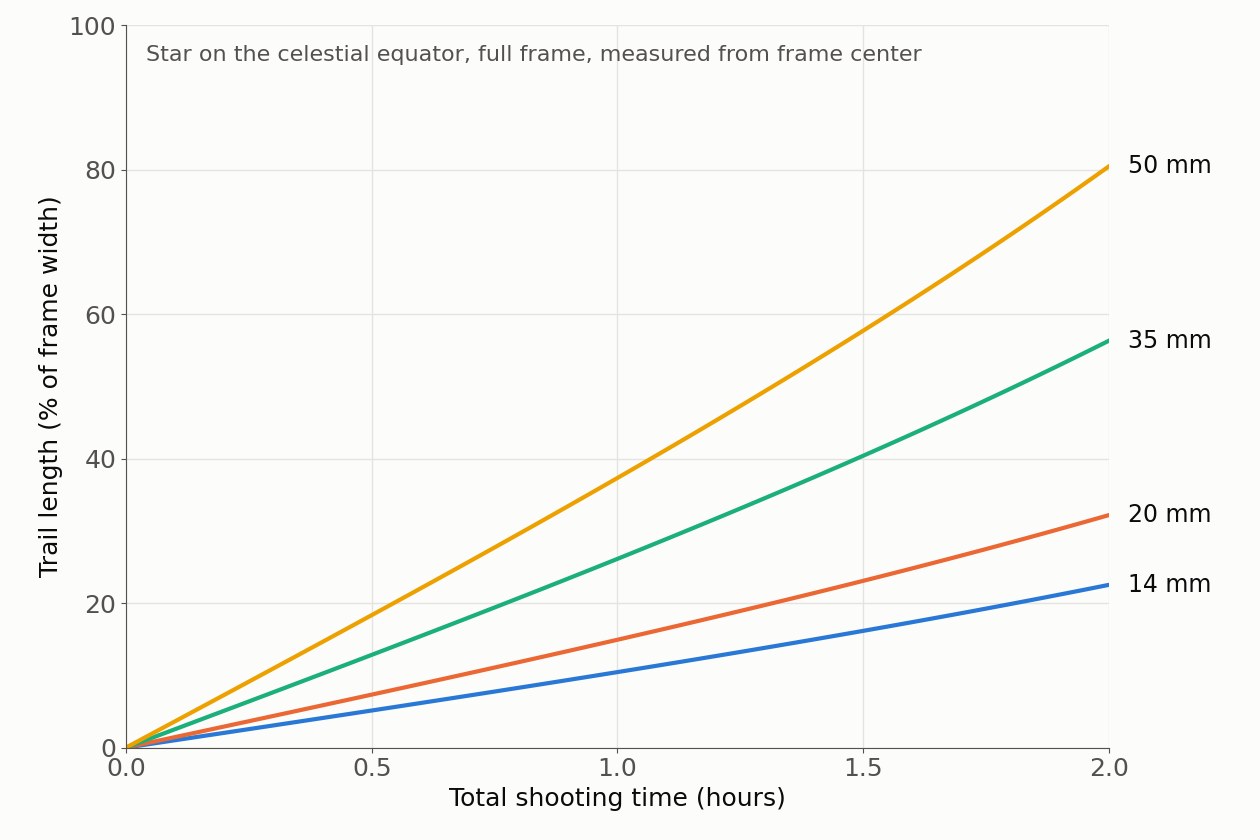
| 50 mm | 2,239 px (37%) | 3,438 px (57%) | 4,007 px (78%) |
One hour of trail for a star on the celestial equator, starting at the frame center. Percent = share of the frame width. Pixel pitch: 6.0 µm, 3.9 µm and 3.4 µm, computed as √(sensor area ÷ pixel count).
Two things stand out. Small sensors draw longer trails at the same focal length, because the same millimeters cross more frame. And a 50 mm lens on Micro Four Thirds runs most of the way across the frame in one hour. A wide-angle lens keeps a long session inside the frame.
A star trail is a 4-second exposure
This is the part most guides skip. A moving star does not sit on one pixel for the whole session. It crosses each pixel and moves on. So every pixel of the trail collects only a few seconds of starlight.
The time per pixel is the pixel pitch divided by the star's speed on the sensor. For a star on the celestial equator:
| Focal length | Full frame, 24 MP | APS-C, 24 MP | Micro Four Thirds, 20 MP |
|---|---|---|---|
| 14 mm | 5.9 s | 3.8 s | 3.3 s |
| 20 mm | 4.1 s | 2.7 s | 2.3 s |
| 24 mm | 3.4 s | 2.2 s | 1.9 s |
| 35 mm | 2.4 s | 1.5 s | 1.3 s |
| 50 mm | 1.6 s | 1.1 s | 0.9 s |
Seconds of starlight per trail pixel = pixel pitch ÷ (focal length × 0.0000729 rad/s). The rotation rate is 2π ÷ 86164 s. Stars nearer the pole move slower and give their pixels more time.
Now the consequence. Trail brightness depends on aperture and ISO, not on how long you shoot. The only thing a longer session adds to a trail is length. The sky behind the trail is different. Its brightness grows with every second the shutter stays open.
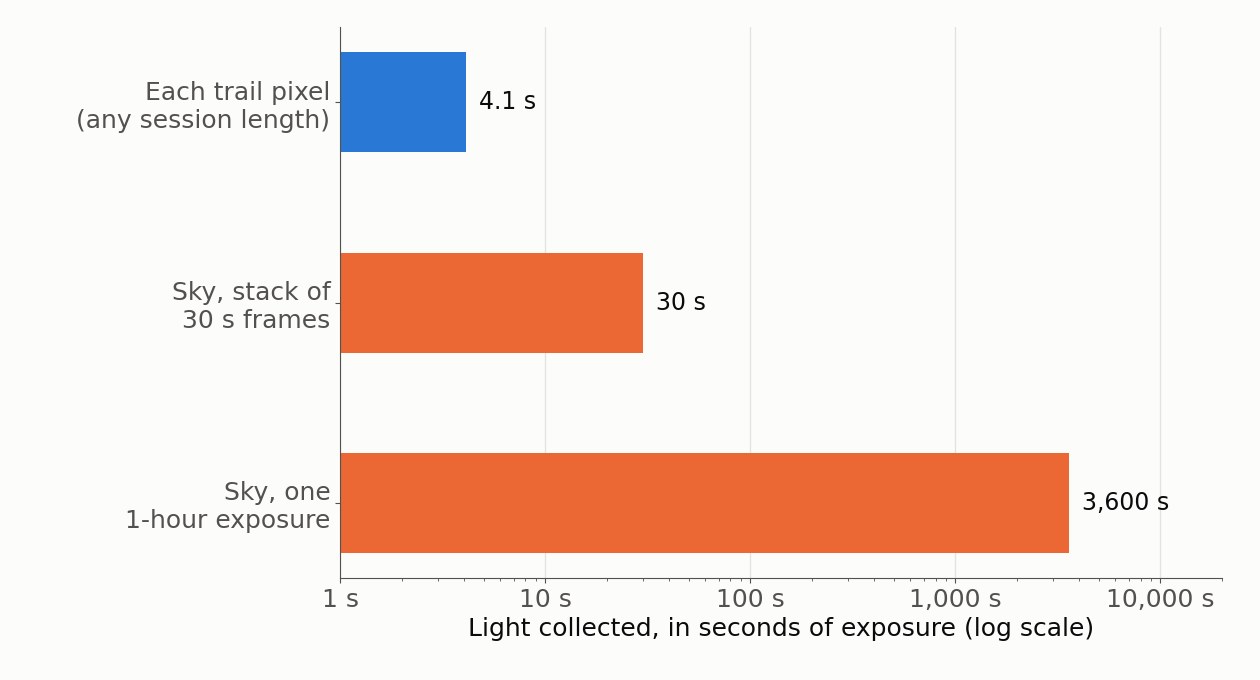
A lighten blend keeps, for each pixel, the brightest value from any frame. Wikipedia's blend-mode article defines Lighten Only that way: the maximum of each component. So in a stack of 30-second frames, the sky stays at one frame's brightness. Each trail pixel keeps its brightest moment, which is its 4.1 seconds of star.
A single one-hour exposure collects 120 times more sky light. That is 6.9 stops. To stop the sky from burning out, you must remove those 6.9 stops with aperture and ISO. Take Digital Photo Mentor's starting point of ISO 3200 and 30 seconds, at f/2.8. Holding that sky brightness over one hour means ISO 100 at about f/5.6. The trails lose the same 6.9 stops.
That matches the old film advice. Wikipedia's star trail article lists ISO 200 and 400 film and apertures like f/5.6 and f/4. It also notes that digital noise grows with exposure time, and that stacking shorter frames avoids it. The stack wins on contrast as well as noise.
Rule of thumb: Shoot short frames at the same settings you would use for a sharp star photo, then stack with a lighten blend. Session length sets trail length. It does not set trail brightness.
Frames needed for a stacked star trail
Frame count is plain division. Frames = session length ÷ (exposure + pause). The table uses a 1-second pause between frames.
| Session | 15 s frames | 20 s frames | 30 s frames | Arc at the celestial equator |
|---|---|---|---|---|
| 30 min | 113 | 86 | 59 | 7.5° |
| 1 h | 225 | 172 | 117 | 15.0° |
| 2 h | 450 | 343 | 233 | 30.1° |
| 3 h | 675 | 515 | 349 | 45.1° |
Frames rounded up. Arc = 15.04° per hour.
Digital Photo Mentor suggests 60 or more 30-second frames. With 1-second pauses, 60 frames cover 31 minutes. That is a 7.8-degree arc, about 455 pixels at 20 mm on a 24 MP full-frame camera. Treat 60 as a floor: an hour doubles the trail.
Count the frames before you leave. Each one costs a file on the card and a share of the battery. Wikipedia's article warns that sessions of hours can deplete camera batteries.
Gaps between frames: when they show
The myth says any pause between frames leaves dotted trails. It is half true. A gap appears only when the star moves farther than its own width during the pause.
How wide is a star? Michaud's NPF derivation models a point star as about 2 pixels across. So the threshold is a star moving 2 pixels in the pause. That happens above this focal length:
| Pause between frames | Full frame, 24 MP | APS-C, 24 MP | Micro Four Thirds, 20 MP |
|---|---|---|---|
| 1 s | 165 mm | 107 mm | 92 mm |
| 2 s | 82 mm | 54 mm | 46 mm |
| 3 s | 55 mm | 36 mm | 31 mm |
Threshold focal length = 2 × pixel pitch ÷ (0.0000729 rad/s × pause), for a star on the celestial equator.
At 14 or 20 mm with a 1-second pause, a star moves well under its own width. No gap forms. At 50 mm with a 3-second pause on a full-frame camera, gaps can appear. StarStaX, a free stacking program, notes that camera pauses can leave small gaps. It offers a Gap Filling mode, an optimized lighten blend, to close them.
If you see gaps at a wide focal length, the actual pause was longer than you set. Check the time stamps of two neighboring frames. The difference minus the exposure time is the actual pause.
Camera settings for star trail frames
Start from your sharp-star settings and stop worrying about trailing. Digital Photo Mentor's Milky Way starting point is ISO 3200, the widest aperture and 15 to 30 seconds. For star trails it uses 30-second frames in a row. Those frames are longer than the NPF limit, and that is fine. The stack is supposed to trail.
Three settings matter more than usual:
- Continuous shooting with a fixed exposure. Every frame needs the same exposure, so use manual mode. The shutter speed guide covers the 30-second limit and Bulb.
- Manual focus at infinity. Autofocus hunts in the dark and can shift between frames.
- A fixed white balance. Auto white balance can drift across hundreds of frames.
The exposure arithmetic is the same as for aurora. The northern lights settings page has a table for trading aperture against ISO, and the NPF tables for when you want sharp stars instead.
What to pack
- A tripod. It holds the frame still for an hour or more. A camera tripod with a solid head is the base of everything here.
- An intervalometer. Check your camera menu for a built-in one first. If it has none, an intervalometer remote fires the frames with a set pause.
- Power for the session. Hundreds of frames drain batteries. Bring spares, or an external power adapter for your camera model.
How the numbers were computed
- Rotation rate: 360° ÷ 23.9345 h = 15.04° per hour (NASA sidereal rotation period). In radians: 2π ÷ 86164 s = 0.0000729 rad/s.
- Path on the sky: 15.04° × hours × cos(declination).
- Distance on the sensor: d = f × tan(rotation angle × cos(declination)), from Michaud's NPF background article.
- Pixel pitch: √(sensor width × height ÷ pixel count), with sensors of 36 x 24 mm, 23.5 x 15.6 mm and 17.3 x 13.0 mm. Real cameras vary slightly by model.
- Seconds per trail pixel: pixel pitch ÷ (focal length × 0.0000729 rad/s).
- Single exposure vs stack: 3600 s ÷ 30 s = 120, which is log₂(120) = 6.9 stops.
- Frames: session ÷ (exposure + 1 s), rounded up.
- Gap threshold: focal length where the star moves 2 pixels during the pause.
Frequently asked questions
- What are star trails?
- Star trails are the arcs stars draw across a long exposure or a stack of frames. The stars stand still. The camera turns with the Earth, once per sidereal day of 23.9345 hours, so every star circles the celestial pole at 15.04 degrees per hour. Point north in the Northern Hemisphere and the arcs center near Polaris.
- How long does it take to photograph star trails?
- Plan by arc length. Every star turns 15.04 degrees per hour around the pole, so 30 minutes gives 7.5 degrees and 2 hours gives 30 degrees. At 20 mm on a 24 MP full-frame camera, one hour draws a trail of about 900 pixels near the celestial equator. A half circle needs almost 12 hours.
- How many photos do you need for star trails?
- Divide the session by the frame cycle: exposure time plus the pause between frames. With 30-second frames and a 1-second pause, one hour takes 117 frames and two hours take 233. With 20-second frames, one hour takes 172. An intervalometer, built in or external, fires them without your hands on the camera.
- Why stack star trail frames instead of one long exposure?
- Because the sky keeps brightening and the trails do not. A trail pixel sees the star only while it passes. That is about 4.1 seconds at 20 mm on a 24 MP full-frame camera. A lighten stack holds the sky at one frame's exposure. A single one-hour exposure collects 120 times more sky light for the same trails.
- Why do my star trails have gaps?
- The camera paused long enough for each star to move farther than its own width. On a 24 MP full-frame camera, a 1-second pause opens a gap only above about 165 mm. A 3-second pause opens one above about 55 mm. Shorten the pause, or use a gap-filling blend mode, which StarStaX offers.
Sources
- Earth Fact Sheet, NASA Space Science Data Coordinated Archive (2026)
- Les coulisses de la règle NPF, Frédéric Michaud, Société Astronomique du Havre (2026)
- Star trail, Wikipedia (2026)
- Blend modes (Lighten Only), Wikipedia (2026)
- StarStaX usage, Markus Enzweiler (2026)
- Star trail and Milky Way photography, settings and planning, Digital Photo Mentor (2026)