Field of view calculator for camera lenses
by Piotr · Photography Tips
Pick a sensor, a focal length and a subject distance. The calculator returns the three angles of view, the frame size at that distance and the full-frame equivalent focal length. It starts on the group photo worked out below.
Field of view calculator
- Horizontal angle
- 37.1°
- Vertical angle
- 25.1°
- Diagonal angle
- 43.9°
- Frame width at 10.5 m
- 7.05 m (23.1 ft)
- Frame height at 10.5 m
- 4.68 m (15.4 ft)
- Full-frame equivalent
- 54 mm (crop 1.53)
Angle = 2 x atan(sensor size / (2 x focal length)), for a rectilinear lens focused far away. Frame size = distance x sensor size / focal length. Fisheye lenses do not follow this formula.
In short: Angle of view = 2 × arctan(sensor size ÷ (2 × focal length)). Frame width = distance × sensor width ÷ focal length. A 35 mm lens on APS-C sees 37.1° across and frames 7.05 m (23.1 ft) at 10.5 m. Both formulas hold for normal lenses focused far away. They fail for fisheyes and drift at close range.
How to read the results
The calculator answers the three main framing questions at once. The angles say how wide the lens sees. The frame size says how much of the scene fits at your distance. The equivalent says which full-frame lens frames the same way.
- Horizontal angle uses the sensor width. It matches how wide a landscape-orientation frame feels.
- Vertical angle uses the sensor height. Turn the camera to portrait orientation and the two swap.
- Diagonal angle uses the sensor diagonal. Most lens spec sheets print this one, so it is the main number for comparing against a catalog.
- Frame width and height are the size of the scene at the subject distance, in meters and feet.
- Full-frame equivalent is the focal length times the crop factor. The crop factor is the full-frame diagonal over your sensor's diagonal: 1.53 for APS-C at 23.5 x 15.6 mm and 2.00 for Micro Four Thirds.
The sensor list holds five formats. The sensor size guide explains where those dimensions come from.
Worked example: framing a group of ten
Here is the classic case. Ten people stand in one row, and you have a 35 mm lens on an APS-C camera. How far back do you go?
- Size the row. Allow 0.6 m (2 ft) per person. Ten people make 6.0 m. Add 0.5 m (1.6 ft) of margin on each side for 7.0 m of frame width.
- Rearrange the coverage formula. Distance = frame width × focal length ÷ sensor width.
- Compute. 7.0 × 35 ÷ 23.5 = 10.43 m (34.2 ft).
- Check the height. At 10.43 m the frame is 4.65 m tall. The row fits with plenty of headroom.
The calculator above is set to 10.5 m, the next half meter up. It shows a frame 7.05 m wide.
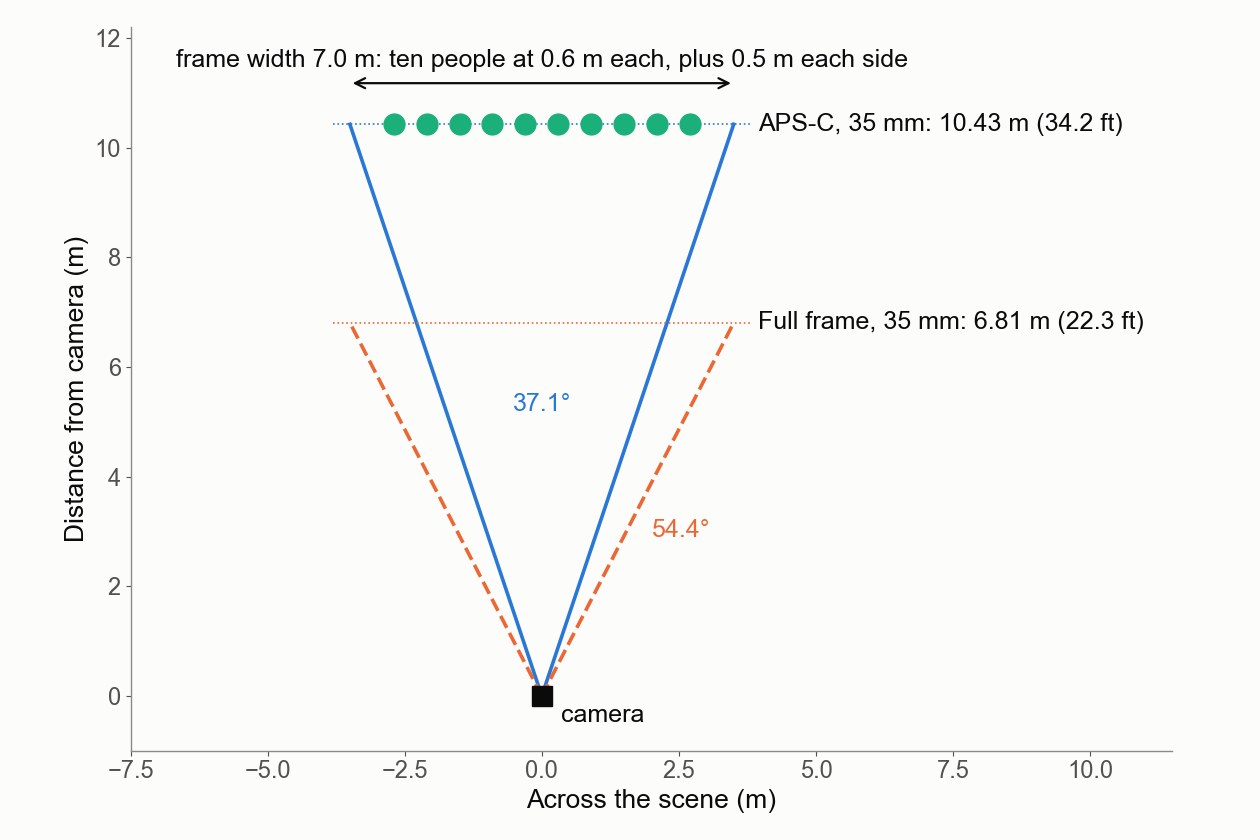
Swap the body for full frame and the same lens needs only 6.81 m (22.3 ft). Put the group in two rows of five instead. Each row is then 3.0 m wide, the frame 4.0 m, and the distance drops to 5.96 m (19.5 ft) on APS-C. Those two numbers decide whether the shot fits a living room or needs the garden.
Distance needed for a given frame width
The worked example generalizes into one table. Find the frame width you need, then read the distance for your lens.
| Focal length | Sensor | 1 m wide | 3 m wide | 7 m wide | 20 m wide |
|---|---|---|---|---|---|
| 24 mm | Full frame | 0.7 m | 2.0 m | 4.7 m | 13.3 m |
| 24 mm | APS-C | 1.0 m | 3.1 m | 7.1 m | 20.4 m |
| 35 mm | Full frame | 1.0 m | 2.9 m | 6.8 m | 19.4 m |
| 35 mm | APS-C | 1.5 m | 4.5 m | 10.4 m | 29.8 m |
| 50 mm | Full frame | 1.4 m | 4.2 m | 9.7 m | 27.8 m |
| 50 mm | APS-C | 2.1 m | 6.4 m | 14.9 m | 42.6 m |
| 85 mm | Full frame | 2.4 m | 7.1 m | 16.5 m | 47.2 m |
| 85 mm | APS-C | 3.6 m | 10.9 m | 25.3 m | 72.3 m |
How the numbers were computed. Distance = frame width × focal length ÷ sensor width, with widths of 36 mm (full frame) and 23.5 mm (APS-C). The 1 m column is approximate, for the close-range reason explained further down.
The 85 mm rows explain why a portrait lens is a poor group lens. A 7 m row needs 16.5 m of clear space on full frame and 25.3 m on APS-C.
When the room is too small, solve for the lens
Indoors, the distance is fixed by the back wall. So turn the formula around once more: focal length = sensor width × distance ÷ frame width.
Say the same 7.0 m row stands in a room where you can back up 4 m. On APS-C you need 23.5 × 4 ÷ 7.0 = 13.4 mm. On full frame you need 36 × 4 ÷ 7.0 = 20.6 mm. Both are wide-angle territory, with the distortion that comes with it. The wide-angle lens guide covers how to keep people at the edges from stretching.
The formulas behind the calculator
Two right triangles do all the work. Half the sensor and the focal length form one. Half the scene and the subject distance form the other. Both share the same angle at the lens.
- Angle of view: 2 × arctan(d ÷ (2 × f)), where d is the sensor width, height or diagonal and f is the focal length. This is the rectilinear formula in the angle of view article.
- Frame size: distance × d ÷ f. Same triangle, read in meters.
- Distance for a frame: frame size × f ÷ d.
- Focal length for a frame: d × distance ÷ frame size.
- Crop factor: 43.27 mm (the full-frame diagonal) ÷ your sensor's diagonal.
The focal length guide runs the angle formula for every common lens from 14 to 600 mm on three formats.
Where the calculator is wrong: close focus
The calculator assumes the lens is focused far away. Focus close and the lens moves away from the sensor, which magnifies the image a little. The real frame is then smaller than the calculator says.
The focal length article gives the thin lens equation behind the correction: 1 ÷ s1 + 1 ÷ s2 = 1 ÷ f. Here s1 is the subject distance and s2 the image distance, both from the lens. The table compares the calculator's full-frame width with the thin-lens width.
| Distance from sensor | 24 mm | 50 mm | 85 mm |
|---|---|---|---|
| 0.5 m | 0.75 m vs 0.68 m (+10.9%) | 0.36 m vs 0.28 m (+27.0%) | 0.21 m vs 0.13 m (+63.2%) |
| 1 m | 1.50 m vs 1.43 m (+5.1%) | 0.72 m vs 0.65 m (+11.5%) | 0.42 m vs 0.35 m (+21.8%) |
| 2 m | 3.00 m vs 2.93 m (+2.5%) | 1.44 m vs 1.37 m (+5.3%) | 0.85 m vs 0.77 m (+9.5%) |
| 5 m | 7.50 m vs 7.43 m (+1.0%) | 3.60 m vs 3.53 m (+2.1%) | 2.12 m vs 2.05 m (+3.6%) |
How the numbers were computed. Calculator width = distance × 36 ÷ f. Thin-lens width = 36 × s1 ÷ s2, where s1 + s2 equals the distance and 1 ÷ s1 + 1 ÷ s2 = 1 ÷ f. The percentage is how much the calculator overstates.
Beyond 5 m the error stays under 4% for these lenses. For groups and landscapes, ignore it. For head shots with an 85 mm lens, expect a tighter frame than the calculator shows. Real lenses with internal focusing depart from the thin-lens model too, so treat close-range numbers as a first estimate.
Where the calculator is wrong: fisheye lenses
A rectilinear lens keeps straight lines straight. The price is that it can never reach 180°: the arctangent only approaches it. A fisheye gives up straight lines to go wider. Per the fisheye lens article, a fisheye is "not fully characterised by focal length and aperture alone". Its mapping function matters too.
| 15 mm lens on full frame | Mapping | Diagonal angle |
|---|---|---|
| Ordinary wide-angle | Rectilinear, r = f × tan(θ) | 110.5° |
| Fisheye | Equidistant, r = f × θ | 165.3° |
| Fisheye | Equisolid angle, r = 2f × sin(θ ÷ 2) | 184.6° |
How the numbers were computed. r is the half-diagonal, 21.63 mm; θ is the half-angle. Each mapping is solved for θ and doubled. Mapping functions are from the fisheye lens article.
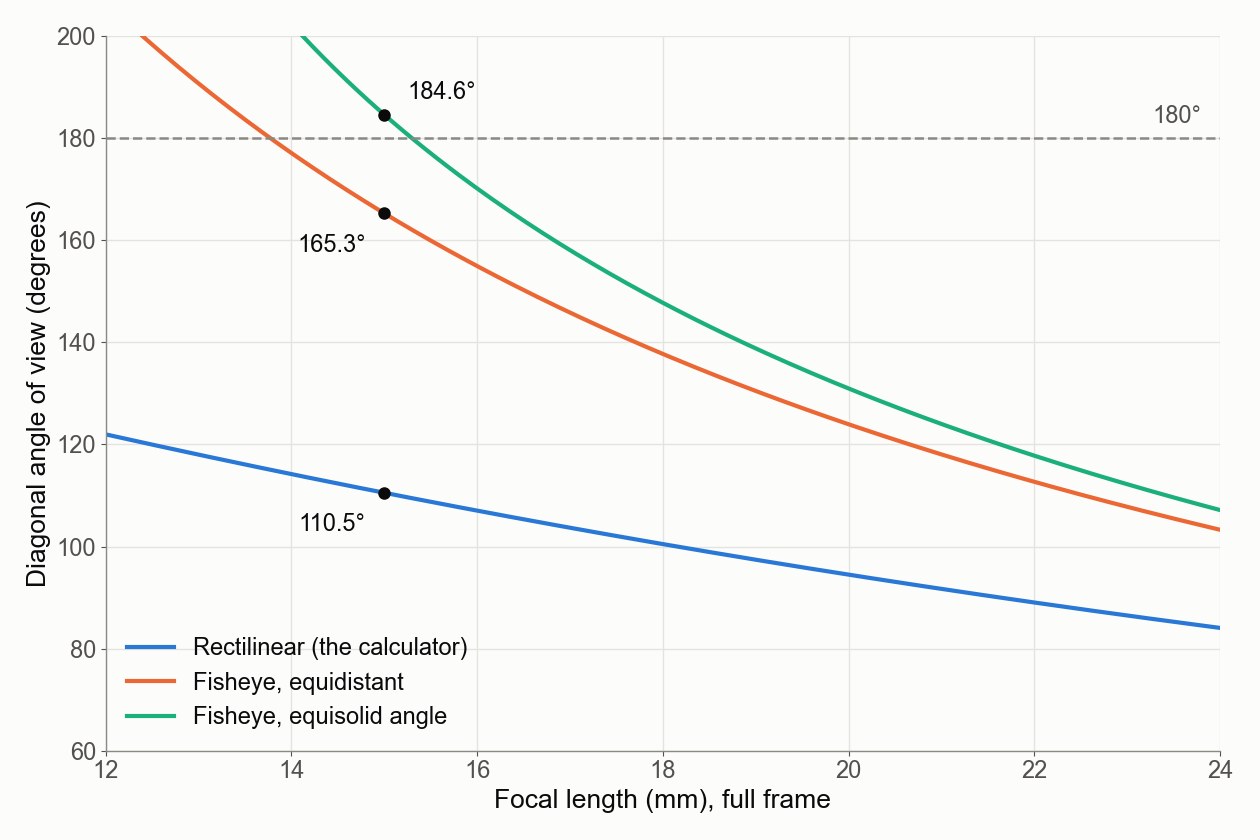
So the same "15 mm" can mean 110.5° or more than 180°. The correct source for a fisheye's angle is the maker's spec sheet. The fisheye lens guide lists the focal lengths that give a full 180° on each format.
The short version: frame width = distance × sensor width ÷ focal length. Rearrange it for distance or for focal length, and you can plan a shot before you arrive. Beyond 5 m it stays within 4% for lenses up to 85 mm. Do not trust it with a fisheye.
Frequently asked questions
- How do you calculate a camera's field of view?
- Use angle = 2 x arctan(sensor size / (2 x focal length)) for a rectilinear lens focused far away. Put in the sensor width for the horizontal angle, the height for the vertical one, and the diagonal for the diagonal one. A 35 mm lens on APS-C (23.5 mm wide) gives 37.1 degrees horizontally. In meters, frame width = distance x sensor width / focal length.
- What is the field of view of a 50mm lens?
- On full frame, a 50 mm lens covers 39.6 degrees horizontally, 27.0 degrees vertically and 46.8 degrees diagonally. At 10 m it frames 7.20 x 4.80 m. On APS-C the same lens covers 26.4 degrees horizontally, the view of a 77 mm lens on full frame. On Micro Four Thirds it covers 19.6 degrees.
- How far back do you need to stand to photograph a group?
- Divide by the lens and multiply by the sensor: distance = frame width x focal length / sensor width. A row of ten people at 0.6 m each, plus 0.5 m of margin on each side, needs a 7.0 m frame. With a 35 mm lens that means 10.43 m on APS-C and 6.81 m on full frame.
- Does sensor size change the field of view?
- Yes. The same lens projects the same image, and a smaller sensor records a smaller part of it. A 35 mm lens covers 54.4 degrees horizontally on full frame, 37.1 degrees on APS-C and 27.8 degrees on Micro Four Thirds. The crop factor, 1.53 for APS-C and 2.00 for Micro Four Thirds, converts one to the other.
- Why does the calculator not work for fisheye lenses?
- The calculator assumes a rectilinear lens, which keeps straight lines straight and can never reach 180 degrees. A fisheye uses a different mapping. On full frame, a rectilinear 15 mm lens covers 110.5 degrees diagonally. An equidistant fisheye at 15 mm covers 165.3 degrees, and an equisolid-angle one 184.6 degrees.
Sources
- Angle of view (photography), Wikipedia contributors (2026)
- Focal length (thin lens equation), Wikipedia contributors (2026)
- Fisheye lens (mapping functions), Wikipedia contributors (2026)