Sunny 16 rule - a computed chart and a test
by Piotr · Photography Tips
As an Amazon Associate I earn from qualifying purchases. Links to Amazon on this page are affiliate links.
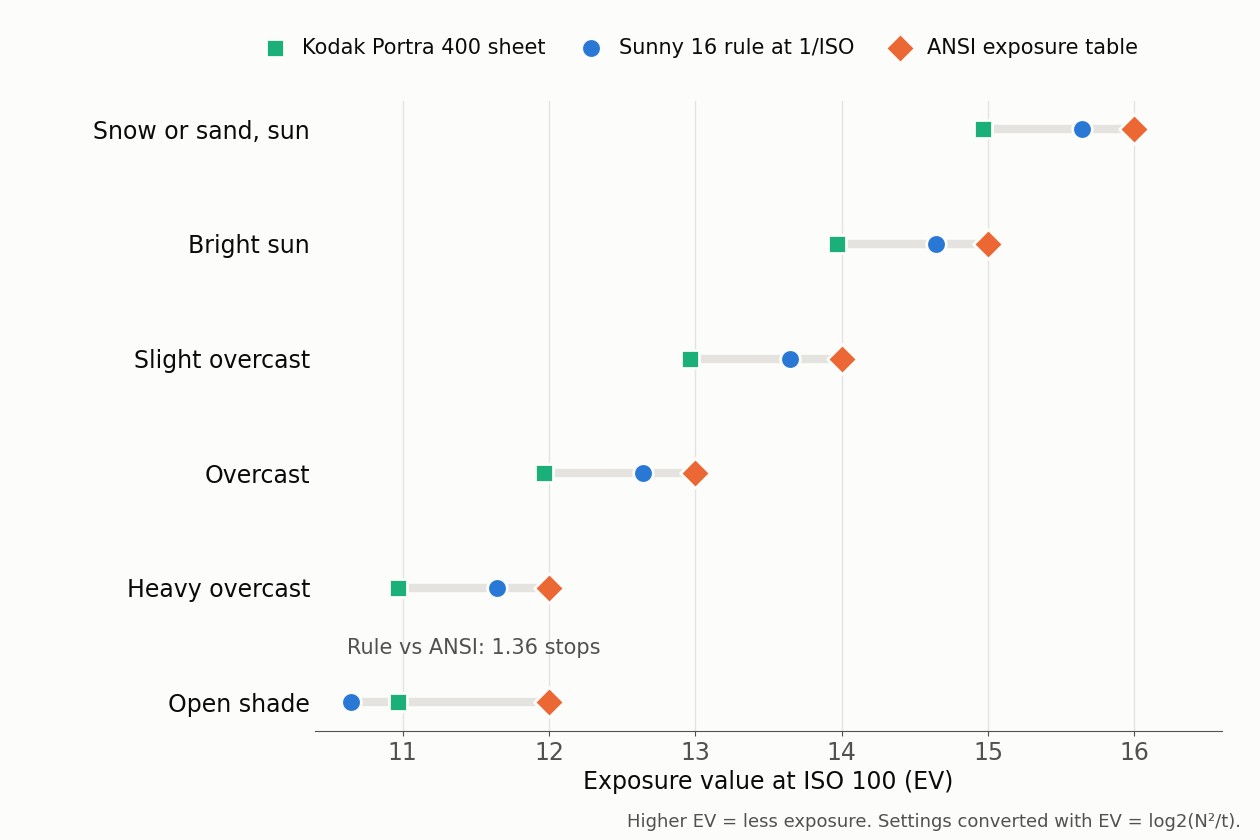
In short: In full sun with sharp shadows, set f/16 and a shutter speed of 1 over your ISO. Open the aperture one stop for each step down in light: f/11, f/8, f/5.6. Checked against the ANSI exposure tables, the rule runs 0.36 stop bright in five of six conditions. In open shade it runs 1.36 stops bright.
The sunny 16 rule is a light meter you carry in your head. It needs no battery. The interesting question is how well. A rule of thumb deserves a ruler, so this page converts every setting to an exposure value and lines it up against two published references. One is the ANSI daylight table. The other is Kodak's own film sheet.
The sunny 16 rule in one line
The rule fits on a matchbook. On a sunny day, set the aperture to f/16. Set the shutter speed to the reciprocal of the ISO. That gives 1/100 s at ISO 100 and 1/400 s at ISO 400. Wikipedia's article on the rule also notes that 1/125 s works at ISO 100 on cameras without a 1/100 s setting.
The rule assumes incident light: the light falling on the scene, not the light bouncing off it. That is its hidden strength. Snow and black cats get the same setting, because the sun shines on both equally.
The full version is a ladder. Each step down in light opens the aperture by one stop and leaves the shutter speed alone. The six rungs come from the exposure table in the Wikipedia article on the rule:
| Light | Shadows | Aperture |
|---|---|---|
| Snow or sand in sun | Dark, sharp edges | f/22 |
| Sunny | Distinct | f/16 |
| Slight overcast | Soft edges | f/11 |
| Overcast | Barely visible | f/8 |
| Heavy overcast | None | f/5.6 |
| Open shade or sunset | None | f/4 |
The shadow column is the meter. Look at the ground next to your own feet and read the edge.
Sunny 16 chart for ISO 100, 200, 400 and 800
Here is the whole rule as one chart. Each cell is the shutter speed the rule prescribes, followed by the exposure value of that setting. All four speeds are standard one-third-stop settings, as the shutter speed chart shows. No rounding is needed.
| Light | Aperture | ISO 100 | ISO 200 | ISO 400 | ISO 800 |
|---|---|---|---|---|---|
| Snow or sand in sun | f/22 | 1/100 s, EV 15.6 | 1/200 s, EV 16.6 | 1/400 s, EV 17.6 | 1/800 s, EV 18.6 |
| Sunny | f/16 | 1/100 s, EV 14.6 | 1/200 s, EV 15.6 | 1/400 s, EV 16.6 | 1/800 s, EV 17.6 |
| Slight overcast | f/11 | 1/100 s, EV 13.6 | 1/200 s, EV 14.6 | 1/400 s, EV 15.6 | 1/800 s, EV 16.6 |
| Overcast | f/8 | 1/100 s, EV 12.6 | 1/200 s, EV 13.6 | 1/400 s, EV 14.6 | 1/800 s, EV 15.6 |
| Heavy overcast | f/5.6 | 1/100 s, EV 11.6 | 1/200 s, EV 12.6 | 1/400 s, EV 13.6 | 1/800 s, EV 14.6 |
| Open shade or sunset | f/4 | 1/100 s, EV 10.6 | 1/200 s, EV 11.6 | 1/400 s, EV 12.6 | 1/800 s, EV 13.6 |
Read across a row and the exposure value climbs by exactly 1 per column. That is the trick inside the rule. The Wikipedia article on exposure value gives the conversion for film speed: EV at speed S equals EV at ISO 100 plus log₂(S/100). Doubling ISO adds one stop to the setting the scene calls for. Halving the shutter time adds one stop to the setting you dial. Setting the time to 1/ISO makes both moves together, so the aperture never changes.
The exposure triangle behind this trade is explained in the exposure triangle explained. What ISO costs you in noise is in what ISO is.
The rule checked against the ANSI exposure tables
The rule runs a third of a stop bright. That is the whole verdict for five rows out of six.
The reference is Table 2 in the Wikipedia article on exposure value. Its daylight figures come from the ANSI exposure guides PH2.7-1973 and PH2.7-1986, rounded to whole numbers. The article flags its 15 for full sun as approximately the sunny 16 value. To compare, convert each sunny 16 setting to its ISO 100 exposure value:
| Light | Sunny 16 at ISO 100 | Rule EV | ANSI EV | Rule minus ANSI |
|---|---|---|---|---|
| Snow or sand in sun | f/22, 1/100 s | 15.64 | 16 | −0.36 |
| Sunny, distinct shadows | f/16, 1/100 s | 14.64 | 15 | −0.36 |
| Hazy, soft shadows | f/11, 1/100 s | 13.64 | 14 | −0.36 |
| Cloudy bright, no shadows | f/8, 1/100 s | 12.64 | 13 | −0.36 |
| Heavy overcast | f/5.6, 1/100 s | 11.64 | 12 | −0.36 |
| Open shade, clear sun | f/4, 1/100 s | 10.64 | 12 | −1.36 |
A negative number means the rule lets in more light than ANSI asks for. The steady 0.36 comes from 1/100 s itself. Use 1/125 s at ISO 100 and the sunny row computes to 14.97, a match to two decimals. So the 1/125 s that old cameras forced on you was the more accurate choice.
The open shade row is the only outlier. ANSI puts open shade and heavy overcast at the same value, EV 12. The common sunny 16 ladder gives open shade its own rung at f/4, a full stop more. In open shade, f/5.6 at 1/ISO is the correct setting by the table.
The Wikipedia article also converts EV 15 into light: 82,000 lux of illuminance, with the common calibration constant of 250. That is the light the rule is built on.
Kodak's own film sheet asks for one more stop
Kodak publishes a daylight table for Portra 400, an ISO 400 color negative film. Every row asks for one more stop of light than ANSI.
| Light (Kodak's wording) | Kodak, ISO 400 | ISO 100 EV | ANSI EV |
|---|---|---|---|
| Bright or hazy sun on light sand or snow | 1/500 s, f/16 | 14.97 | 16 |
| Bright or hazy sun, distinct shadows | 1/500 s, f/11 | 13.97 | 15 |
| Weak, hazy sun, soft shadows | 1/500 s, f/8 | 12.97 | 14 |
| Cloudy bright, no shadows | 1/500 s, f/5.6 | 11.97 | 13 |
| Heavy overcast or open shade | 1/500 s, f/4 | 10.97 | 12 |
The offset is a constant 1.03 stops. A margin that steady is a choice, not a disagreement about sunlight. The sheet does not explain it, and it is written for negative film. A digital sensor punishes extra light instead: blown highlights cannot be recovered, as metering modes and the histogram shows. On a digital camera, trust the ANSI column, not the film sheet.
Kodak also merges heavy overcast and open shade into one row, exactly as ANSI does. Three references, and the sunny 16 ladder is the only one that splits them.
Equivalent exposures: f/16 at 1/100 s equals f/8 at 1/400 s
Once the rule gives one correct setting, reciprocity gives you all the others. Each full stop wider halves the time. The exposure value stays at 14.64 in every row below, computed with the same formula.
| Aperture | ISO 100 | ISO 200 | ISO 400 | ISO 800 |
|---|---|---|---|---|
| f/22 | 1/50 s | 1/100 s | 1/200 s | 1/400 s |
| f/16 | 1/100 s | 1/200 s | 1/400 s | 1/800 s |
| f/11 | 1/200 s | 1/400 s | 1/800 s | 1/1600 s |
| f/8 | 1/400 s | 1/800 s | 1/1600 s | 1/3200 s |
| f/5.6 | 1/800 s | 1/1600 s | 1/3200 s | 1/6400 s |
| f/4 | 1/1600 s | 1/3200 s | 1/6400 s | 1/12800 s |
| f/2.8 | 1/3200 s | 1/6400 s | 1/12800 s | 1/25600 s |
| f/2 | 1/6400 s | 1/12800 s | 1/25600 s | 1/51200 s |
| f/1.4 | 1/12800 s | 1/25600 s | 1/51200 s | 1/102400 s |
Pick the row by what the aperture does to the picture. At ISO 100, f/8 and 1/400 s freeze a walking person and keep a street sharp. At f/2 the background goes soft, the subject of what aperture is.
Wide apertures hit the shutter's top speed
The bottom of that table is where sunny 16 meets hardware. A fast lens wide open in full sun asks for shutter speeds a mechanical shutter cannot give.
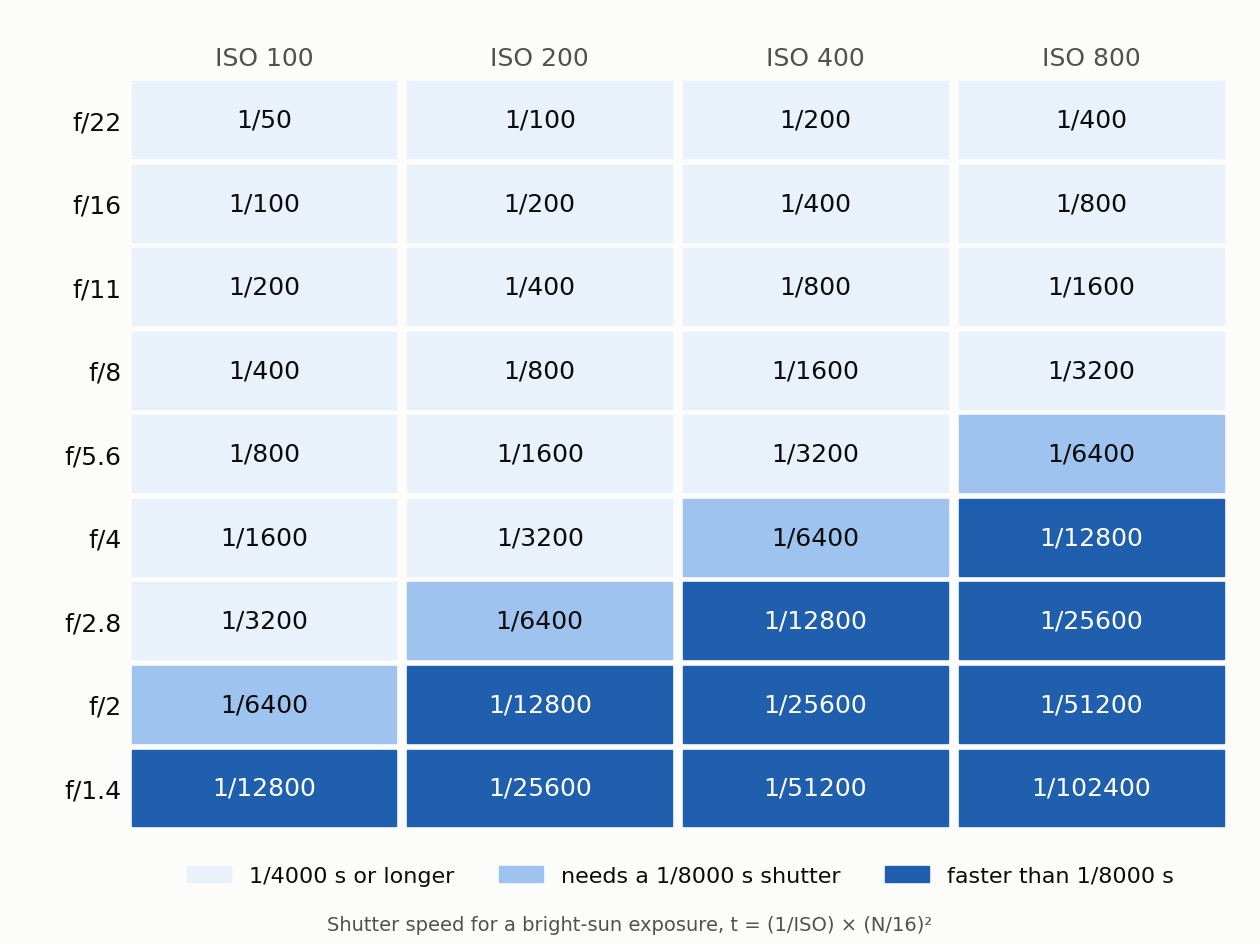
The first fix is free: drop to your lowest ISO. The second is a neutral density filter. Its stops are log₂ of the filter factor, so an ND2 takes 1 stop, an ND4 2 stops and an ND8 3 stops. Here is the smallest filter that brings each case back into range, rounded up to a whole stop:
| Setting in full sun | Needs | Top speed 1/4000 s | Top speed 1/8000 s |
|---|---|---|---|
| f/2 at ISO 100 | 1/6400 s | ND2 | none |
| f/1.4 at ISO 100 | 1/12800 s | ND4 | ND2 |
| f/2.8 at ISO 400 | 1/12800 s | ND4 | ND2 |
| f/2 at ISO 400 | 1/25600 s | ND8 | ND4 |
| f/1.4 at ISO 400 | 1/51200 s | ND16 | ND8 |
So a portrait at f/1.4 on a sunny afternoon is a filter problem, not a talent problem. A two-stop ND4 filter covers most of the table on a 1/8000 s body. An ND8 covers ISO 400 film. Filter strengths and how to choose one are in ND filters for long exposure.
Backlight, side light and the time of day
The rule has fine print, and the published sources disagree about it.
- Time of day. The ANSI notes say the direct-sun values apply from about two hours after sunrise to two hours before sunset. Outside that window, the sun is weaker than the rule assumes.
- Side light. ANSI says to lower the exposure value by 1, which means one stop more light.
- Backlight. ANSI says to lower it by 2. Kodak asks for f/5.6 instead of f/11 on backlit close-ups, also 2 stops. The common sunny 16 table says to add one stop.
Two published references against one rule of thumb. For a backlit face, open two stops.
Using the rule on a digital camera
On a digital camera the rule is a cross-check, not a replacement for the meter. It shines where the meter fails: snow, a white wall, a black car. Those scenes fool a reflected-light meter, as metering modes and the histogram explains. They do not fool the sun.
Rule of thumb: Switch to manual, set your lowest ISO, then f/16 and 1/ISO for sharp shadows, one stop wider for each softer step. Take one frame and check the histogram. If the rule and the meter disagree in plain front light, check the histogram before you trust either.
- Look at the shadows and pick a rung: sharp, soft, barely visible, none.
- Set the aperture from the ladder and the shutter speed to 1/ISO.
- Move to the aperture you want with the equivalent-exposure table.
- Add one stop for side light and two for backlight.
- Check the histogram after the first frame and adjust.
How the numbers were computed
Every exposure value on this page uses the formula from the Wikipedia article on exposure value: EV = log₂(N²/t), with N the f-number and t the time in seconds. Settings at other ISO speeds convert to ISO 100 with EV₁₀₀ = EV − log₂(S/100). The f-numbers use their exact values, powers of √2, so f/11 is 11.31 and f/22 is 22.63. The Wikipedia article on the rule gives that √2 step per stop. Equivalent shutter times are t = (1/ISO) × (N/16)². Filter stops are log₂ of the filter factor, rounded up to a whole stop.
Verdict
The sunny 16 rule is accurate to a third of a stop. Use 1/125 s at ISO 100 and it matches the ANSI table outright. Its weak rung is open shade, where f/5.6 beats the traditional f/4. Its main limit is your shutter: wide apertures in full sun need an ND filter. Learn the ladder, read the shadows, and the rule will outlast every meter battery you own.
Frequently asked questions
- What is the sunny 16 rule?
- It is a way to set exposure without a meter. On a sunny day with sharp shadows, set the aperture to f/16 and the shutter speed to 1 over your ISO: 1/100 s at ISO 100, 1/400 s at ISO 400. For dimmer light you open the aperture one stop per step: f/11 for slight overcast, f/8 for overcast, f/5.6 for heavy overcast.
- Does the sunny 16 rule actually work?
- Mostly, yes. Converted to exposure values, the rule sits 0.36 stop brighter than the ANSI exposure table in five of six light conditions. That is inside a third of a stop of rounding. The exception is open shade. There the common sunny 16 table says f/4, while the ANSI table implies f/5.6: a gap of 1.36 stops.
- What is the sunny 16 rule for ISO 400?
- In bright sun with distinct shadows, use f/16 at 1/400 s. The equivalent settings are f/11 at 1/800 s, f/8 at 1/1600 s and f/5.6 at 1/3200 s. At f/4 the exposure needs 1/6400 s. A camera whose shutter tops out at 1/4000 s then needs an ND2 filter or a lower ISO.
- What is the sunny 16 rule for ISO 200?
- Bright sun calls for f/16 at 1/200 s. Each stop wider halves the time. So f/11 takes 1/400 s, f/8 takes 1/800 s, and f/4 takes 1/3200 s. For slight overcast, keep 1/200 s and open to f/11. For overcast, use f/8, and for heavy overcast, f/5.6.
- Why is the shutter speed 1 over the ISO?
- Exposure value and ISO both count in doublings. Doubling ISO adds one stop to the exposure value the scene calls for, and halving the shutter time takes one stop away. Setting the time to 1 over the ISO makes the two changes cancel, so f/16 stays correct at every ISO. The arithmetic is in the chart section below.
- Does the sunny 16 rule work with backlight?
- Not as written. It assumes front light between about two hours after sunrise and two hours before sunset. The ANSI notes say to give 1 extra stop for side light and 2 for backlight. Kodak asks for 2 extra stops on backlit close-ups. The common sunny 16 table adds only one stop for backlight.
Sources
- Sunny 16 rule, Wikipedia (2026)
- Exposure value (Table 2, values from ANSI PH2.7-1973 and PH2.7-1986), Wikipedia (2026)
- KODAK PROFESSIONAL PORTRA 400 Film, technical data E-4050, Kodak Alaris (2016)